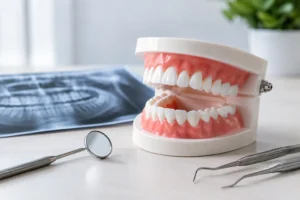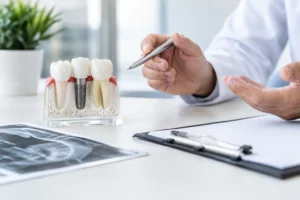

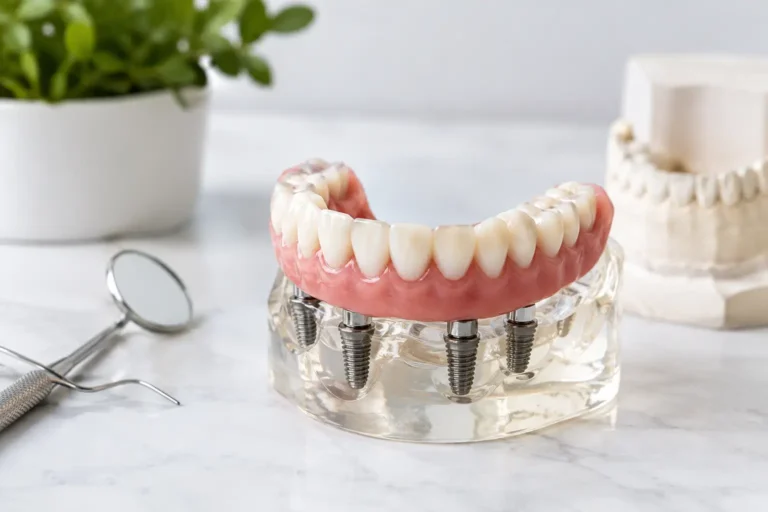
A loose lower denture can turn an ordinary meal into a careful calculation. You may avoid steak, apples or meals with friends because you are worried the denture will move, click or lift when you speak. Implant supported dentures are designed to address that instability by anchoring replacement teeth to dental implants placed in the jawbone.
They can be a highly effective solution for people who have lost several or all of their teeth, or whose remaining teeth are no longer predictable to maintain. However, the right result is not simply a matter of placing implants. It depends on the health and volume of your bone, the way your jaws meet, the design of the replacement teeth and the skill with which the entire treatment is planned.
What are implant supported dentures?
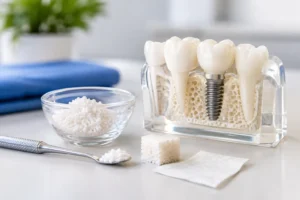
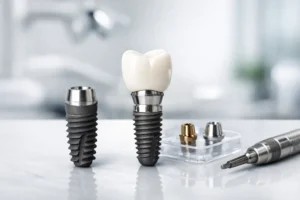
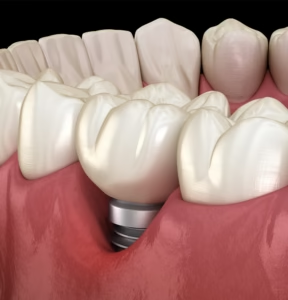
An implant supported denture is a prosthesis held in place by implants rather than relying only on suction, adhesive or the shape of the gums. The implants act as artificial tooth roots. Once they have integrated with the bone, they provide stable support for a removable denture or a fixed full-arch bridge.
This matters most in the lower jaw. Conventional lower dentures often move because there is limited surface area for retention and the tongue constantly challenges their position. Even two well-positioned implants can dramatically improve security for a removable lower denture. For patients who want a fixed solution, more implants may support a full arch of teeth that remains in place day and night.
The phrase covers several different treatments. An implant-retained overdenture is removable by the patient and clips or attaches onto implants. A fixed implant bridge is secured by the clinician and is not removed at home. All-on-Four, All-on-Six and All-on-X are full-arch approaches in which a planned number of implants supports a fixed bridge. The most suitable option depends on your anatomy, bite forces, appearance goals and ability to maintain the prosthesis.
Fixed or removable: the decision is personal and clinical
A fixed bridge often feels closest to having natural teeth. It can provide excellent chewing efficiency, confidence in social situations and a natural-looking smile when it is carefully designed. It also requires a committed cleaning routine. You need to clean beneath the bridge every day, usually with specialised brushes, floss aids and sometimes a water irrigator. Fixed does not mean maintenance-free.
A removable implant-retained denture can be an excellent choice when you want greater stability without the cost or complexity of a fixed full arch. It is removed for cleaning, allowing direct access to the denture and gums. Some patients also prefer this because it is easier to inspect and maintain as they get older. The trade-off is that it may still have a small amount of movement compared with a well-designed fixed bridge, and attachments require periodic servicing.
Neither option is automatically better. A patient with strong jaw muscles and a history of grinding may need a particularly robust design and careful bite management. Someone with reduced dexterity may benefit from a solution that is easier to clean. The aim is not to recommend the most extensive treatment, but the treatment that can be maintained comfortably and predictably over time.
Why the bite matters as much as the implants
Implants do not have the cushioning ligament that natural teeth possess. This makes precision essential. If a full-arch bridge is too bulky, poorly positioned or takes excessive force in one area, the porcelain, acrylic or framework can chip, loosen or wear prematurely. More importantly, the implants and surrounding bone can be placed under avoidable stress.
A prosthodontic assessment looks beyond the missing teeth. It considers facial proportions, lip support, speech, the vertical height of your bite, jaw joint comfort and how forces are distributed when you chew. This is particularly important when replacing an entire arch, where the teeth need to restore both function and facial support without looking artificial.
The treatment journey: planning before placement
The first consultation should establish whether implants are appropriate and what outcome you are hoping to achieve. Existing dentures, failing teeth, gum condition and medical history all provide valuable information. Photographs, digital scans, X-rays and usually three-dimensional imaging are used to assess available bone and plan implant positions.
Where teeth cannot be saved, they may be removed and implants placed at the same appointment. In selected cases, a provisional fixed bridge can be fitted soon afterwards. This is often called immediate loading. It can be a valuable option, but it is not a promise that should be made before the bone quality, infection risk, bite and implant stability have been assessed. In other cases, a period of healing, bone grafting or gum preparation produces the safer long-term foundation.
Once healing is complete, detailed records are taken to design the final teeth. This stage deserves time. The shape, shade and position of the teeth are refined alongside speech and bite. A temporary bridge can be useful because it allows the clinician and patient to assess comfort and appearance before the final prosthesis is made.
At Maison Dentaire, full-arch treatment is personally planned and delivered by a specialist prosthodontist, with particular attention to functional bite design and long-term maintainability. Premium implant systems are only one part of the equation. The planning, surgical positioning and final restorative design must work together.
Who may be suitable for implant supported dentures?
Many people assume they are not candidates because they have worn dentures for years or have been told they have bone loss. Bone loss can affect the treatment approach, but it does not always rule implants out. Modern planning may identify areas where implants can be placed safely, or indicate when grafting or another restorative approach should be considered.
Good candidates are not defined by age alone. General health, smoking status, diabetes control, gum health, bone quality and commitment to hygiene are more relevant. People who clench or grind their teeth can still be treated, but their prosthesis may need additional protection, such as a night guard, and closer review.
There are circumstances where implants should be delayed or may not be advisable. Uncontrolled medical conditions, active gum disease, inadequate oral hygiene and some medications require careful assessment. An ethical recommendation should include these limitations clearly rather than presenting implants as a universal answer.
Benefits that patients notice day to day
The main benefit is stability. When a denture is secure, patients often find they can chew a wider variety of foods and speak without constantly checking its position. Improved support can also reduce sore spots caused by a denture rocking over the gums.
Implants can help preserve jawbone by transferring chewing forces into the bone. They cannot restore every bit of bone already lost, and they do not stop all change indefinitely, but they are generally more protective than a conventional denture resting on the gums alone. Thoughtful tooth positioning can also improve lip support and facial appearance.
It is worth keeping expectations realistic. Implant supported dentures should feel secure and comfortable, but they are still a dental prosthesis. You may notice differences in sensation, and you will need time to adapt to chewing and speaking with a new bite. Follow-up adjustments are a normal part of achieving a refined result.
Looking after your investment
Long-term success depends on cleaning and review appointments. Plaque can collect around implants just as it can around natural teeth. If inflammation is left untreated, bone around an implant can be lost. This condition, known as peri-implant disease, is often preventable with effective home care and professional maintenance.
For removable designs, clean the denture and attachment components daily, and follow instructions on how to store it. For fixed bridges, cleaning under the bridge is essential. Your clinician should demonstrate the technique and check that you can manage it before treatment is complete.
Components also wear. Retentive clips, locator inserts and screws may need replacement or tightening over the years. A repair is not necessarily a treatment failure. It is part of maintaining a complex restoration that works hard every day.
Questions to ask before you decide
Before committing to treatment, ask what type of prosthesis is being proposed, why that design suits your situation and how it will be cleaned. You should also understand whether grafting is likely, what provisional teeth you will have during healing, how complications are managed and what future maintenance may involve.
Written treatment planning and transparent fees are especially valuable for full-arch care because the process has several clinical and laboratory stages. The cheapest initial proposal is not always the least costly over time if the design compromises comfort, cleanability or repairability.
A well-planned implant solution should give you more than teeth that look convincing in photographs. It should make everyday eating, speaking and smiling feel less guarded, while giving you a practical way to protect the result for years to come.