
A guide to implant bone grafting should begin with one reassuring fact: needing a graft does not mean dental implants are out of reach. It simply means there may not yet be enough healthy bone in the right position to support an implant predictably. The purpose of grafting is not to add treatment unnecessarily. It is to create a stable foundation for a restoration that looks natural, functions comfortably and is designed to last.
For patients replacing a single tooth, several teeth or a full arch, bone quality is one of the most important details in implant planning. A specialist assessment determines whether grafting is needed, what type is appropriate and whether treatment can proceed in stages or at the same time as implant placement.
Why bone matters for dental implants
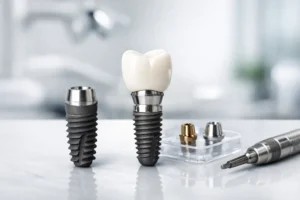
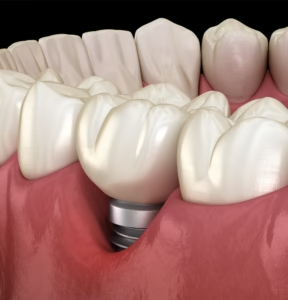
A dental implant is placed into the jawbone, where it gradually bonds with the surrounding bone during healing. This biological connection provides the stability needed to support a crown, bridge or fixed full-arch restoration.
When a tooth has been missing for some time, the bone that once supported it can shrink in height and width. This happens because the jaw is no longer receiving the stimulation created by chewing through the tooth root. Gum disease, infection, trauma, previous extractions and ill-fitting dentures can also contribute to bone loss.
An implant does not always require a large volume of bone. Modern implant systems offer different lengths and diameters, and careful positioning can make treatment possible in situations that once appeared difficult. However, there must still be sufficient bone around the implant for long-term stability and to support the gum contours that frame the final tooth. Placing an implant where bone is inadequate may compromise its position, appearance or prognosis.
Guide to implant bone grafting: when is it needed?
Bone grafting is considered when the available jawbone is too thin, too short or unevenly shaped for an implant to be placed safely in the ideal position. It may be required before implant treatment, at the time an implant is placed, or after an extraction to preserve the socket for a future implant.
A three-dimensional scan is usually central to this decision. It allows the clinician to assess bone volume, the location of neighbouring teeth, the sinus in the upper jaw and important nerves in the lower jaw. This is far more precise than judging bone levels from a conventional dental X-ray alone.
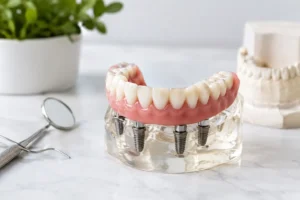
Not every patient with bone loss needs a graft. In some cases, an implant can be placed by selecting an appropriate implant design and angulation. For full-arch rehabilitation, including All-on-Four or All-on-X treatment, implants may sometimes be positioned strategically in areas where stronger bone remains. This can reduce the need for extensive grafting and shorten the overall treatment process. It depends on the anatomy of the jaw, the health of the remaining teeth and gums, bite forces, aesthetic requirements and the design of the final restoration.
A responsible plan does not start with a predetermined procedure. It starts with the outcome required: stable teeth, healthy surrounding tissues, a comfortable bite and a result that can be maintained over time.
The main types of bone graft
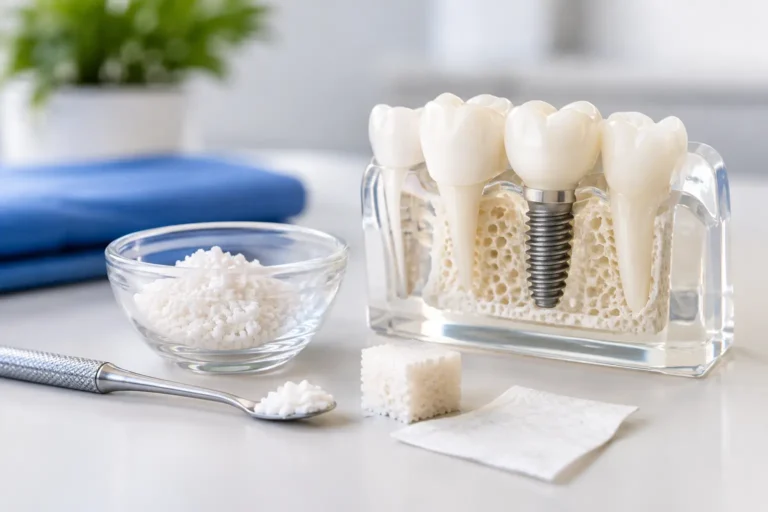
Bone graft material acts as a framework that supports the body’s own bone-forming process. Over time, new bone develops within and around the graft material. The material selected depends on the size and location of the defect, whether an implant is being placed simultaneously and the clinician’s treatment objectives.
Socket preservation after extraction
When a tooth is removed, the empty socket naturally heals, but some collapse of the surrounding bone is expected. Socket preservation involves placing graft material into the extraction site, often with a protective membrane, to reduce this loss. It can be particularly valuable in visible areas, where preserving bone and gum shape supports a more natural-looking future crown.
Socket preservation does not guarantee that no further grafting will be needed. It improves the conditions for a future implant and can make later treatment more straightforward.
Guided bone regeneration
Guided bone regeneration is used where bone needs to be built up in width or around part of an implant. Graft material is placed at the deficient area and covered with a membrane. The membrane helps prevent soft tissue from growing into the space while bone healing takes place.
This approach may be performed at the same appointment as implant placement if primary implant stability can be achieved. Where the deficiency is larger, grafting may be completed first, followed by implant placement after healing.
Sinus grafting in the upper jaw
The back of the upper jaw often loses bone height after upper molars are removed because the maxillary sinus sits above this area. A sinus graft gently creates space beneath the sinus lining, allowing graft material to support new bone formation.
A smaller sinus lift may be performed alongside implant placement when enough existing bone is present. More substantial bone loss may require a staged procedure. A detailed scan is essential, as sinus anatomy differs considerably between patients.
Block grafting for larger defects
Where there is a significant deficiency in the jaw ridge, a block graft may occasionally be recommended. This uses a shaped piece of bone material to rebuild the area before implants are placed. It is a more involved procedure and has a longer healing period, but it can be appropriate where conventional grafting cannot provide enough support.
What is the graft material made from?
Patients often ask whether the graft becomes part of their jaw. The answer depends on the material used and the body’s healing response. Some grafts are gradually replaced by the patient’s own bone, while others remain partly present as a stable mineral scaffold.
Common options include processed human donor bone, animal-derived mineral grafts and synthetic materials. In selected cases, a patient’s own bone may be used. Each option has advantages and limitations. The right choice is based on the clinical situation rather than a one-size-fits-all preference.
What matters most is that the material is used appropriately, handled under strict clinical protocols and protected during healing. The graft alone does not determine success. Surgical technique, blood supply, infection control, gum health and the final implant position are equally significant.
What treatment and healing involve
Bone grafting is carried out under local anaesthetic. For many patients, the procedure is more manageable than anticipated, particularly when it is carefully planned and performed with a minimally invasive approach. Some swelling, tenderness and bruising are normal in the days afterwards. Pain is commonly controlled with prescribed or recommended medication, and patients receive clear aftercare instructions.
Healing time varies. A minor socket graft may need several months before implant placement, while a larger graft can require a longer period. If a small amount of grafting is completed during implant placement, the implant may still need several months to integrate before it can support the final restoration.
During this period, temporary teeth may be provided where appropriate. For patients having multiple teeth removed or undergoing full-arch treatment, the temporary phase must be planned as carefully as the surgery. It needs to protect healing sites while allowing the patient to speak and function with confidence.
Smoking, uncontrolled diabetes, active gum disease and poor oral hygiene can reduce healing predictability. Heavy pressure on a temporary restoration can also disturb a grafted area. These factors do not always rule out treatment, but they need honest discussion before committing to a plan.
Why implant planning should come before grafting
A graft should be planned around the intended implant and final tooth, not simply placed to make an area look fuller on a scan. The eventual restoration determines where the implant needs to sit, how it must emerge through the gum and how biting forces will be managed.
This is particularly relevant in the smile zone and in full-mouth rehabilitation. An implant placed too far towards the cheek or tongue can be difficult to restore attractively and clean effectively, even if it has integrated successfully. Likewise, a full-arch bridge needs to be designed around the patient’s facial support, speech, lip position and bite, not only the available bone.
At Maison Dentaire, implant and grafting decisions are approached through prosthodontic planning: the final teeth, bite and long-term maintenance are considered from the outset. This helps ensure that any grafting performed has a clear purpose within the wider treatment plan.
Questions worth asking at your consultation
A thorough consultation should leave you clear about whether grafting is necessary, whether there are alternatives and how it affects cost and timing. Ask what the scan shows, where bone is deficient and whether the graft is being placed before or with the implant. You should also understand the expected healing period, the provisional tooth option and the risks specific to your case.
Bone grafting adds time and, in some cases, surgical complexity. Yet avoiding a genuinely necessary graft can create a more difficult problem later. The aim is neither to over-treat nor to take shortcuts, but to make a measured decision that gives your implant restoration the foundation it deserves.