
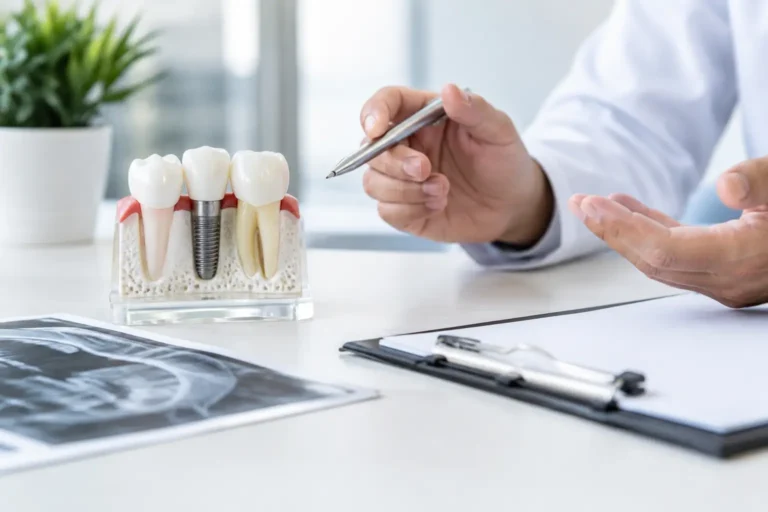
A dental implant consultation should do more than confirm whether an implant can be placed. It should establish whether it is the right treatment for your mouth, your bite and the way you want to live. The right implant consultation questions help you move beyond a simple price comparison and understand the quality, planning and long-term care behind the recommendation.
This matters particularly if you have several failing teeth, have worn a denture for years, or are considering a fixed full-arch solution such as All-on-Four, All-on-Six or All-on-X. These treatments can be life-changing, but they are also highly individual. A plan that works well for one person may not be suitable for another.
What a proper implant consultation should involve
A meaningful consultation is an assessment, not a sales appointment. Your clinician should review your medical and dental history, examine your gums and teeth, assess the way your jaws meet, and discuss your expectations. Digital scans and three-dimensional imaging are often necessary to assess bone volume, nerve locations, sinus anatomy and the positions available for implants.
For full-mouth rehabilitation, the discussion should be broader still. Your clinician needs to consider which teeth can genuinely be retained, the health of the supporting bone and gums, facial support, speech, smile design and the forces created by your bite. Replacing teeth without considering these factors can lead to avoidable complications or restorations that do not feel natural.
You should leave with a clear explanation of the findings, realistic options and a written treatment plan. If further information is needed before a final recommendation is made, that is usually a sign of careful planning rather than uncertainty.
12 implant consultation questions worth asking
1. Am I suitable for implants, and why?
Most adults can be considered for implants, but suitability is not simply a yes or no answer. Gum disease, untreated decay, smoking, uncontrolled diabetes, certain medications and teeth grinding can affect healing and long-term success. Ask how these factors apply specifically to you and what can be improved before treatment begins.
2. Can any of my natural teeth be saved?
An implant is not automatically better than a healthy, maintainable natural tooth. Sometimes a tooth can be retained with periodontal treatment, root canal care, a crown or other restorative work. In other cases, keeping a badly compromised tooth may undermine the result of a larger treatment. Ask for the clinical reasons behind each recommendation, including the likely prognosis of every tooth involved.
3. Do I have enough bone, and will I need grafting?
Bone shrinks after tooth loss, particularly where a tooth has been missing for a long time. A three-dimensional scan can show whether implants can be placed predictably in the available bone or whether grafting, a sinus lift or another approach should be considered.
Grafting is not always required, and it is not something to avoid at all costs. In some cases, it creates a better foundation for a long-lasting result. In others, carefully selected implant positions or a full-arch protocol may avoid it. The best option depends on anatomy, treatment goals and the level of predictability required.
4. Who will plan and carry out my treatment?
Ask who is responsible for the diagnosis, surgical planning, implant placement and final teeth. Implant dentistry combines surgery, restorative dentistry and bite management. For complex cases, especially where several teeth or a full arch are involved, continuity of care matters.
A specialist prosthodontist is trained to plan the final teeth, function and appearance from the outset, rather than treating implant placement as an isolated procedure. This helps ensure the implant positions support a stable, cleanable and natural-looking restoration.
5. Which implant system will be used?
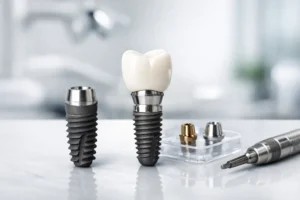
Implants are medical devices designed to remain in the jaw for many years. It is reasonable to ask which system is being recommended and why. Established international systems offer a strong evidence base, precise component compatibility and better long-term availability of restorative parts.
The implant brand alone does not determine success. Diagnosis, surgical precision, restoration design, hygiene and maintenance are equally influential. However, a reputable system is an appropriate part of a quality-led treatment plan.
6. What are my options if I am replacing all or most of my teeth?
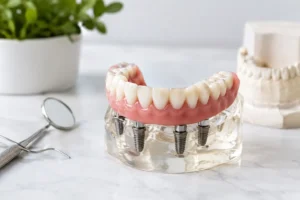
There is no single full-arch implant treatment that suits everyone. All-on-Four generally uses four strategically placed implants to support a fixed bridge. All-on-Six uses six implants, which may offer additional support where anatomy and bite forces make this beneficial. All-on-X simply refers to a tailored number of implants chosen for the individual case.
Ask why a particular number of implants is proposed, whether any teeth should be retained and whether you will receive a fixed bridge, an implant-retained removable prosthesis or another design. The decision should be based on bone, opposing teeth, bite forces, hygiene ability, budget and expectations, not on a one-size-fits-all package.
7. Will I have teeth during treatment?
For visible areas and full-arch cases, patients often need a provisional restoration while implants heal. Ask whether this will be fixed or removable, how quickly it can be provided and what foods or activities to avoid during the healing period.
Immediate fixed teeth may be possible in selected cases, but they are not appropriate for every patient. Implant stability, bone quality, infection control and bite forces must be favourable. A clinician who explains when immediate loading is not advisable is protecting the final result.
8. How will you plan my bite and appearance?
Implant restorations should be designed around more than tooth shade. Ask how the proposed teeth will support your lips, suit your facial proportions, affect speech and meet the opposing teeth. If you grind or clench, this should be identified before the final restoration is made.
The way the teeth meet, known as occlusion, is central to implant longevity. Implants do not have the same shock-absorbing ligament as natural teeth, so excessive forces need to be managed carefully through design, materials and, where appropriate, a protective night guard.
9. What does the timeline look like?
Treatment may take a few months or longer, depending on whether extractions, gum treatment, grafting or staged healing are needed. Ask what happens at each stage, how many visits are likely, when you can return to normal eating and when the final teeth will be fitted.
A longer timeline is not necessarily a drawback. Sometimes it is the safest route to stable healing and a more predictable aesthetic result.
10. What is included in the quoted fee?
A transparent quote should distinguish between scans, extractions, grafting, implants, provisional teeth, final restorations, sedation if required and review appointments. Ask what might change the cost and when you would be informed.
For full-arch treatment, clarify the material planned for the final bridge and whether replacement components, repairs or maintenance are included. The least expensive initial quote may not represent the best long-term value if essential stages or durable materials have been excluded.
11. What are the risks, and how would complications be managed?
No surgical treatment is free from risk. Implants can fail to integrate, gums can become inflamed, screws can loosen and restorations can chip or wear. Smoking, poor plaque control and uncontrolled grinding increase these risks.
Ask how likely the relevant risks are in your case, how they are reduced and what happens if a problem occurs. Clear discussion should be reassuring, not alarming. It demonstrates that your clinician is planning for long-term care rather than promising a risk-free outcome.
12. What maintenance will I need after treatment?
Implants need ongoing professional review and daily cleaning. The exact routine depends on the restoration design, but you may need interdental brushes, specialised flossing aids or a water flosser. Fixed full-arch bridges must be designed so that you can clean beneath them effectively.
Ask how often reviews are recommended, whether your bite will be checked and how future wear is managed. Long-term success is a partnership between precise treatment and consistent maintenance.
Bring your priorities into the conversation
Before your appointment, think about what you most need to change. It may be being able to eat confidently, stopping a denture from moving, avoiding repeated repairs, improving the appearance of failing teeth or simply knowing what can be saved. Share any previous dental experiences and any anxiety you have about treatment. These details help shape a plan that is clinically sound and personally manageable.
If you are comparing options, compare the quality of the planning as well as the number of implants or headline fee. A carefully considered treatment plan should explain what is necessary, what is optional and what may be better postponed. At Maison Dentaire, this specialist-led approach is intended to protect function, comfort and appearance for the years ahead.
The most useful consultation is one in which you feel informed rather than pressured. Ask the questions that matter to you, take time to consider the answers and choose a plan you can maintain with confidence.