
For someone who is tired of loose teeth, repeated repairs, or avoiding certain foods, the question of all on six versus dentures is not simply about replacing teeth. It is about choosing how you want to eat, speak, socialise and care for your mouth over the years ahead. Both options can restore a full smile, but they work in fundamentally different ways and suit different clinical situations.
The right choice should not be based on a single scan, an attractive before-and-after photograph, or a standard package. It requires careful assessment of the jawbone, gum health, bite, facial support, medical history and expectations. Just as importantly, it requires an honest discussion about maintenance and long-term commitment.
All on Six versus dentures: the essential difference
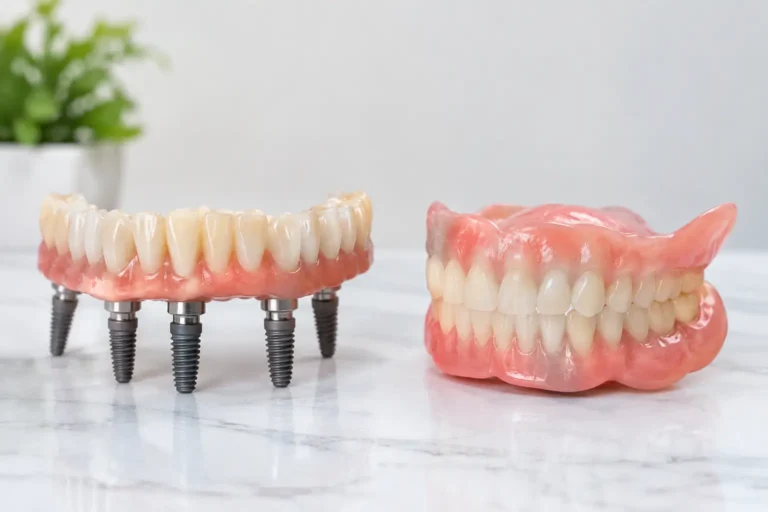
A conventional full denture is a removable prosthesis that rests on the gums. It replaces the visible teeth and can support the lips and cheeks, particularly where there has been substantial tooth and bone loss. Upper dentures often gain some suction from the palate. Lower dentures are usually less stable because the tongue, cheeks and a flatter lower ridge can move them during function.
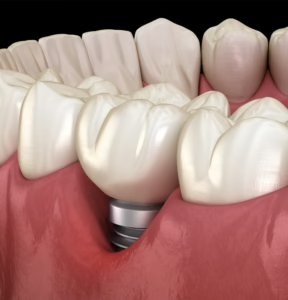
All-on-Six is a full-arch implant treatment. Six dental implants are placed in the jaw to support a fixed full arch of replacement teeth. The final bridge is secured to the implants rather than resting on the gums, so it is not removed by the patient each night. It is designed and planned as a prosthetic reconstruction of the whole arch, not simply as six implants with teeth attached.
This distinction affects almost every part of daily life: how firmly the teeth feel, which foods are manageable, how the bite is controlled, how cleaning is carried out and how future maintenance is approached.
When dentures remain a sensible choice
Dentures are sometimes spoken about as though they are automatically a second-best option. That is not accurate. A well-designed specialist denture can be attractive, comfortable and highly functional, particularly when it is carefully shaped to support the face and balanced against the opposing teeth.
Dentures may be appropriate when surgery is not advisable, when bone volume is limited and grafting is not wanted, or when a patient prefers a non-surgical solution. They can also be the right interim option while the mouth heals, medical circumstances are stabilised, or a more complex rehabilitation is being planned.
A denture can be adjusted, relined or remade as the mouth changes. This flexibility matters because the jawbone and gum tissues continue to alter after teeth have been lost. However, the same changes can gradually reduce denture retention and fit. A lower denture that was comfortable initially may become increasingly mobile as the ridge resorbs.
The everyday compromises of removable dentures
Even excellent dentures have physical limits. They may move under load, particularly with firmer or sticky foods. Some people need time to adapt their speech, and upper dentures cover the palate, which can affect the perception of taste and temperature. Adhesives may improve confidence for some wearers, but they do not address an unstable foundation or an ill-fitting denture.
Dentures must be removed for cleaning and should be left out overnight to allow the tissues to rest. This routine is straightforward for many people, but others find it inconvenient or feel less confident without their teeth in place.
What All-on-Six can offer
The principal advantage of an All-on-Six restoration is fixed stability. Because the arch is anchored to implants, it can feel closer to natural teeth during speaking and eating. Patients often value being able to eat with more security and no longer worrying that their teeth will lift, click or loosen in conversation.
Using six implants can provide broad support for a full arch where the anatomy allows. The distribution of implants, their position in relation to available bone, and the way the final bridge manages chewing forces all matter. More implants do not automatically mean a better outcome in every case. The aim is a stable, cleansable and biologically sound restoration, planned for the individual jaw.
Implants also transmit functional forces into the jawbone. Although they do not recreate every feature of natural tooth roots, they can help maintain the bone around the implant sites when they remain healthy and appropriately loaded. This is one reason implant-supported teeth can be particularly valuable for patients concerned about the progressive changes associated with long-term tooth loss.
A fixed bridge still needs disciplined care
An All-on-Six bridge is fixed, but it is not maintenance-free. Food debris and plaque can collect beneath the bridge, around the implants and at the gum line. Daily cleaning with the right brushes, interdental aids and, where advised, a water flosser is essential.
Professional review is equally important. The bridge, bite, implant tissues and components need regular assessment. Over time, protective materials may wear, screws may require checking, and changes in bite can need attention. A full-arch implant bridge is a long-term prosthesis that deserves long-term supervision.
The clinical questions that should guide the decision
A good treatment plan begins with diagnosis rather than a predetermined answer. Three patients who all describe themselves as needing “a full set of teeth” may require very different solutions.
The first question is whether there are teeth worth retaining. Teeth that are healthy or predictably treatable should not be removed simply to make room for implants. Where teeth are severely worn, mobile, repeatedly infected or no longer restorable, full-arch replacement may be considered. The decision should be based on prognosis, not convenience.
Bone quantity and quality are then assessed through detailed imaging. An All-on-Six plan depends on placing implants in positions that are safe and capable of supporting the intended bridge. The relationship to the sinuses, nerves and existing bone shape is critical. Sometimes the anatomy supports fixed treatment without major additional procedures; sometimes it does not.
Your bite is another decisive factor. Patients who clench or grind their teeth place substantial force on restorations. This does not necessarily rule out implants, but it changes the design, materials, protective measures and maintenance plan. A stable bite is central to the longevity of any full-mouth rehabilitation.
Finally, consider practical matters honestly. Implant treatment involves surgery, healing and several clinical stages. In suitable cases, temporary fixed teeth may be provided soon after implant placement, but this is not appropriate for everyone and should not be mistaken for the final result. The definitive bridge is made after the tissues and implants have been properly assessed during healing.
Appearance is about more than white teeth
Whether you choose dentures or All-on-Six, natural appearance depends on planning the teeth in the right position for your face, lips, speech and bite. Teeth that are too long, too bulky or too white can look artificial even when the technical work is sound.
Dentures can offer valuable lip support because the acrylic base replaces some of the lost gum and tissue volume. A fixed implant bridge may also include carefully designed pink restorative material where needed, but the extent of bone and tissue loss affects what can be achieved. This is why photographs, facial analysis, speech assessment and diagnostic previews are so useful before irreversible treatment begins.
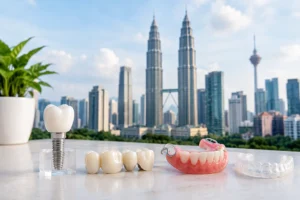
Patients travelling to Kuala Lumpur for complex rehabilitation should allow adequate time for consultation, treatment stages and follow-up planning. A written plan should set out the clinical sequence, the type of temporary restoration where relevant, the expected review schedule and what ongoing care will be needed once you return home.
Choosing the option you can maintain
The best option is not always the most fixed or the most technically advanced. It is the option that offers an acceptable balance of function, appearance, biology, treatment burden and maintainability for you.
At Maison Dentaire, full-arch decisions are planned by a specialist prosthodontist with close attention to implant position, bite and the design of the final teeth. That level of planning matters because a full arch should be judged not only by how it looks at fitting, but by how confidently it can serve you in the years after.
If you are deciding between a fixed implant bridge and dentures, ask for an explanation that is specific to your mouth: what can be retained, what risks need managing, how each option will be cleaned, and what happens if your needs change. A clear answer to those questions is a far better foundation than a quick promise of a new smile.