
A fixed full-arch bridge can change far more than a smile. For someone who has spent years avoiding certain foods, worrying about a loose denture, or managing failing teeth, the question of all on four versus six is really about stability, comfort and confidence over the long term. The right answer is not determined by a standard package. It depends on your bone, bite, medical history, aesthetic needs and the way the final teeth need to function.
All on Four versus Six: the essential difference
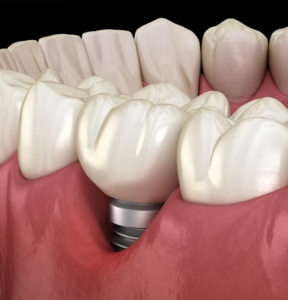
Both All-on-Four and All-on-Six are full-arch implant treatments. A complete set of fixed replacement teeth is supported by implants placed in the jawbone, rather than resting on the gums like a conventional denture. The replacement bridge is designed to restore the appearance of teeth, lip support where needed, speech and chewing function.
The difference is straightforward: All-on-Four uses four implants to support one full arch, while All-on-Six uses six. However, the clinical decision is more complex than simply assuming that more implants must always be better.
With All-on-Four, the two implants towards the front of the jaw are usually placed vertically. The posterior implants are commonly angled to make use of available bone and avoid anatomical structures, such as the maxillary sinus in the upper jaw or the nerve canal in the lower jaw. This can allow a fixed solution without extensive bone grafting in carefully selected cases.
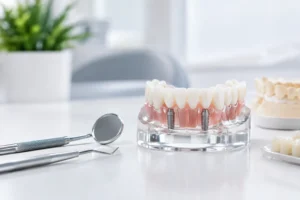
All-on-Six adds two further implants, usually distributed across the arch to provide additional support. Where sufficient bone is available, this can reduce the span carried by each implant and may offer useful biomechanical advantages, particularly for patients with stronger biting forces or a broader arch.
Why implant number is only one part of the decision
A full-arch bridge is not simply a row of individual crowns attached to implants. It is a carefully engineered restoration. Its long-term success depends on implant position, bone support, the design and material of the bridge, the opposing teeth, and how forces are distributed when you chew.
A well-planned four-implant case can be an excellent and durable solution. Equally, six poorly positioned implants do not automatically create a better outcome. The aim is to place the right number of implants in the right positions, using the available bone intelligently and planning the final teeth before surgery begins.
This is why a specialist prosthodontic assessment matters. Prosthodontics focuses on restoring teeth, bite function and appearance. Treatment planning begins with the desired final result, then works backwards to determine where implants should be placed to support it predictably.
Bone volume and bone quality
The amount and density of bone are major factors. Significant bone loss is common after teeth have been missing for many years, particularly in the back of the upper jaw. Angled implants in an All-on-Four design may avoid the need for grafting in some patients, making treatment more efficient and reducing surgical intervention.
If there is good bone across the arch, six implants may be appropriate. More implant sites can provide a wider foundation for the bridge. Yet if placing additional implants requires complex grafting with little clear benefit, that may not be the most conservative choice. Treatment should be based on sound clinical reasoning, not on a fixed implant count.
Bite forces and habits
Your bite can place very different demands on a full-arch restoration. Patients who clench or grind their teeth, have powerful jaw muscles, or require a long bridge span may benefit from additional support or a design that carefully manages force. The lower jaw, where bite forces are often higher, deserves particular attention.
Night-time grinding does not automatically rule out either option. It does mean the bridge design, implant distribution, materials and protective maintenance plan must be considered in greater detail. A night guard may be recommended after treatment to protect both the bridge and the implants.
The shape of your jaw and smile
A broad, curved arch may offer space for six well-distributed implants. In a narrower arch, or where anatomy limits safe placement, four implants may provide the more sensible foundation. The upper and lower jaws are also assessed separately. It is entirely possible for a patient to have four implants in one arch and six in the other.
Aesthetic planning matters just as much. The final bridge must support the lips appropriately, show a natural tooth proportion and sit in a position that allows you to speak comfortably. If gum and bone loss are extensive, the bridge may need to replace both teeth and lost gum tissue. This affects its shape, hygiene access and the placement of the smile line.
Is All-on-Six always stronger?
Not necessarily. Six implants can offer more points of support, but strength is not determined by number alone. Implant length and diameter, bone integration, the absence of excessive cantilevers, bridge material, bite adjustment and daily maintenance all contribute to longevity.
A cantilever is the section of a bridge that extends beyond the last supporting implant. It can be used safely within appropriate limits, but an excessively long cantilever increases leverage on the implants. In some cases, six implants help shorten that extension. In others, thoughtful four-implant placement achieves a satisfactory result without adding surgical complexity.
The material chosen for the final bridge also matters. A provisional fixed bridge may be fitted first while implants heal and the bite is refined. The definitive bridge is then made after careful assessment of aesthetics, speech, comfort and function. This staged approach allows the final restoration to be designed around your real-world needs rather than assumptions made on the day of surgery.
Immediate fixed teeth: when is it possible?
Many patients ask whether they can leave surgery with fixed teeth on the same day. Immediate loading may be possible for either All-on-Four or All-on-Six when implants achieve sufficient primary stability and your clinical situation is suitable. It is not a promise that should be made before proper examination and scans.
Factors such as bone quality, infection, whether teeth need to be removed, medical conditions and bite forces can affect the decision. When immediate loading is appropriate, the first fixed bridge is usually provisional. It protects the implants and restores appearance and function during healing, while you follow a carefully controlled diet.
If immediate loading is not advisable, a temporary removable solution may be safer. A short-term compromise can protect the long-term outcome. The priority is stable healing, not rushing a result at the expense of predictability.
What the planning process should include
Before recommending an implant number, your clinician should assess your teeth, gums, jaw joints, bite and facial proportions. Three-dimensional imaging helps evaluate bone volume and identify vital anatomy. Photographs, digital records and, where indicated, diagnostic previews help plan the position of the final teeth.
You should also receive a clear explanation of what can be retained and what cannot. Sometimes a full arch is genuinely the best solution. In other cases, saving well-supported natural teeth may be more conservative and beneficial. Implant treatment should never begin with the assumption that every compromised tooth must be removed.
At Maison Dentaire, full-arch treatment is planned and delivered by Dr. Lee Pei Nee, a registered specialist prosthodontist. The focus is on the final bite and bridge design as well as the surgery itself, using premium implant systems selected for reliable long-term support. A detailed written treatment plan allows you to understand the sequence, fees, provisional stage and maintenance requirements before making a decision.
Questions patients often ask
Will six implants cost more than four?
Usually, yes. Two extra implants involve additional components, surgical time and planning. But the total cost of treatment also depends on extractions, grafting, sedation, temporary teeth, the definitive bridge material and follow-up care. Comparing a single headline price rarely gives a meaningful picture. Ask what is included and how the final bridge will be planned and maintained.
Are fixed implant teeth difficult to clean?
They require a different routine, not less care. You will need to clean around and beneath the bridge with appropriate brushes, flossing aids or a water flosser, as advised. Regular professional reviews are essential so the bridge, implants, gums and bite can be checked. Peri-implant disease can develop around implants if plaque is not controlled.
Can an existing denture be converted into fixed teeth?
Often, a current denture provides helpful information about tooth position, lip support and appearance. It cannot always be used as the final bridge, but it can guide planning for a fixed restoration. The amount of bone, condition of the gums and desired final result still need a full assessment.
Choosing between four and six implants should feel considered, not confusing. The most reassuring plan is one that explains why each implant is needed, how your bridge will be supported and what will protect your result for years to come.