
A missing molar can be easy to ignore at first. It is out of sight, and you may still be able to eat on the other side. Yet missing molar solutions deserve careful consideration because molars carry much of the force of chewing and help keep the bite stable. Replacing one is not simply about filling a gap. It is about restoring function in a way that protects the teeth, jaw and restoration over time.
The right option depends on where the tooth was lost, the condition of neighbouring teeth, the amount of available bone, your bite, and how you want the replacement to feel and function. A detailed assessment should guide the decision, rather than a standard recommendation.
Why a missing molar can affect more than chewing
Molars are designed to grind food efficiently. When one is absent, people often unconsciously move chewing to the other side. This can place greater demand on the remaining teeth and jaw muscles. Some patients notice no immediate problem, while others develop food trapping, discomfort when eating, or a sense that their bite has changed.
Over time, the teeth beside the space may tilt towards it, while the tooth in the opposing jaw can move downwards or upwards in search of contact. These changes do not happen at the same rate for everyone, but they can make later replacement more complex. The bone that once supported the missing tooth may also gradually reduce in volume.
There are occasions when leaving a space is reasonable, particularly where the last molar is missing and the bite remains stable. However, this should be a considered clinical decision after assessing the full mouth, not an assumption that a back tooth does not matter.
The main missing molar solutions
A single dental implant and crown
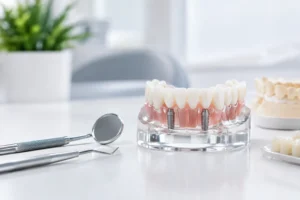
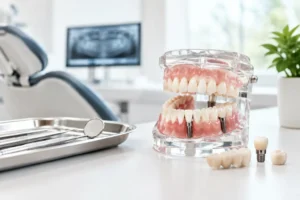
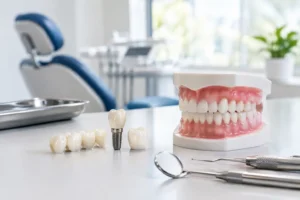
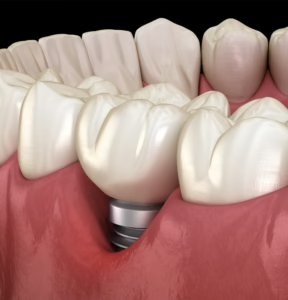
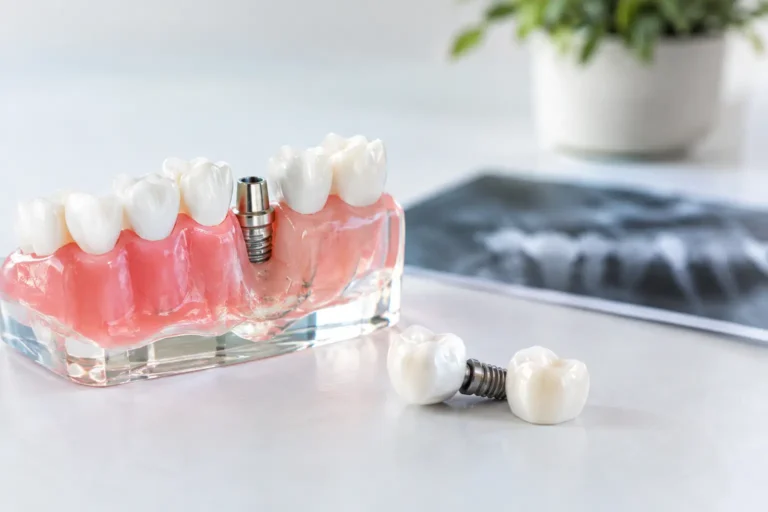
For many suitable patients, an implant-supported crown is the closest replacement for a natural individual molar. A small titanium implant is placed in the jawbone to act as an artificial tooth root. After healing and integration, a carefully designed crown is attached to it.
The principal advantage is that the adjacent teeth do not need to be reduced to support the restoration. An implant can also help preserve function in the area of the missing root and provides a fixed tooth that does not need to be removed for cleaning. For a molar, however, strength is only one part of the planning. The crown must be shaped and positioned precisely so that it meets the opposing teeth evenly and does not receive excessive force.
Implant treatment is not a shortcut. It requires sufficient bone, healthy conditions around the planned site, excellent oral hygiene and an assessment of how you bite and clench. If bone volume is limited, preparatory treatment may be needed before an implant can be placed safely. The overall process takes time, but that time allows healing and accuracy at each stage.
At Maison Dentaire, implant treatment is planned and delivered personally by a registered specialist prosthodontist, with the final restoration designed around both appearance and long-term bite function.
A conventional dental bridge
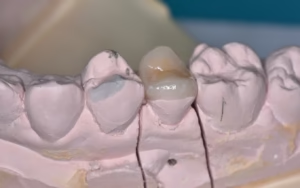
A conventional bridge replaces the missing tooth by joining a new tooth to crowns on one or both neighbouring teeth. It is fixed in place and can restore chewing function without implant surgery. A bridge may be particularly appropriate when the teeth next to the gap already need crowns because of large existing restorations, fracture or significant wear.
The trade-off is that otherwise healthy adjacent teeth usually need to be shaped to receive the supporting crowns. Bridges also require careful cleaning underneath the replacement tooth. If plaque accumulates around the supporting teeth, the bridge can be compromised even if the artificial tooth itself is intact.
A well-designed bridge can provide excellent service, but it must be planned with the bite in mind. The supporting teeth need adequate strength, and the bridge should distribute chewing forces predictably. It is not automatically the best option simply because it can be completed without implant placement.
A removable partial denture
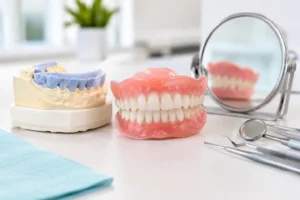
A partial denture is a removable appliance that replaces one or more missing teeth. It can be a practical solution when several teeth are absent, when a fixed restoration is not suitable, or while longer-term treatment is being planned. Modern materials and careful design can make a partial denture more comfortable and discreet than many people expect.
For a single missing molar, a removable denture is usually chosen when an implant or bridge is not advisable, or when it offers the most sensible way to replace multiple spaces. It does require a period of adjustment, daily removal for cleaning and regular review as the mouth changes.
The quality of the fit matters greatly. A poorly fitting denture can move during chewing, rub the tissues or place unwanted force on remaining teeth. Specialist design considers the way the appliance is supported, where it contacts the teeth, and how it affects speech and function.
Choosing between an implant, bridge or denture
The best choice is rarely determined by one factor alone. An implant may preserve neighbouring teeth, but it relies on adequate bone and a suitable medical and oral health profile. A bridge avoids surgery and can be highly effective when adjacent teeth need restoration, but it involves those teeth in the treatment. A partial denture may avoid more invasive treatment, but it is removable and generally less stable than a fixed option.
A proper consultation should examine the whole picture. This includes the size and position of the space, the quality of existing fillings or crowns, the opposing teeth, signs of tooth wear, jaw joint symptoms and any clenching or grinding habits. Digital imaging may be used to assess the bone and identify important anatomical structures before implant treatment is considered.
It is equally important to discuss your priorities. Some patients value the fixed feel of an implant above all else. Others prefer to avoid surgery, or have neighbouring teeth that make a bridge the logical treatment. There is no benefit in choosing a technically impressive solution if it does not suit the mouth or the patient.
Why bite planning matters for molar replacement
Back teeth receive substantial pressure during chewing. A restoration that is fractionally too high, too narrow or poorly positioned can create strain that may not be obvious immediately. It can lead to discomfort, chipping, loosening or excessive wear elsewhere in the mouth.
For this reason, restoring a molar should involve more than matching the shade of the tooth. The shape of the chewing surface, contact with neighbouring teeth and relationship with the opposing arch all matter. Where several teeth are missing or failing, these details become even more significant because a full-mouth rehabilitation may be needed to re-establish a stable bite.
A specialist prosthodontic approach focuses on this functional foundation. The visible crown is the final part of the treatment, but its long-term success depends on what has been assessed and planned before it is fitted.
Looking after your replacement tooth
No restoration is maintenance-free. Implant crowns, bridges and dentures all need regular professional review, along with consistent home care. Cleaning around an implant crown or under a bridge is particularly important because the supporting tissues and neighbouring teeth remain vulnerable to inflammation and decay.
If you clench or grind your teeth, a protective night guard may be recommended to reduce overload on the restoration. Attend reviews even when everything feels comfortable. Small changes in bite, wear or fit are often easier to manage when identified early.
A missing molar does not always require the same answer, but it does deserve a precise one. The most reassuring next step is a consultation that considers your bite, remaining teeth and long-term goals before deciding how the space should be restored.