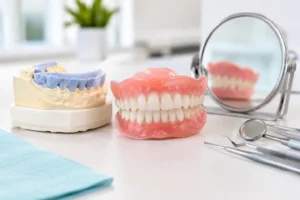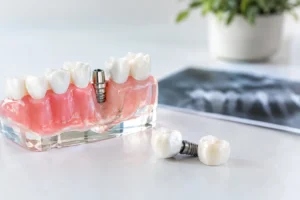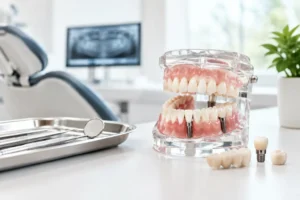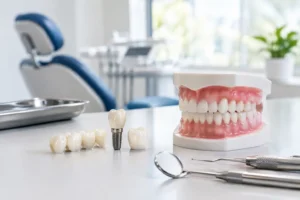

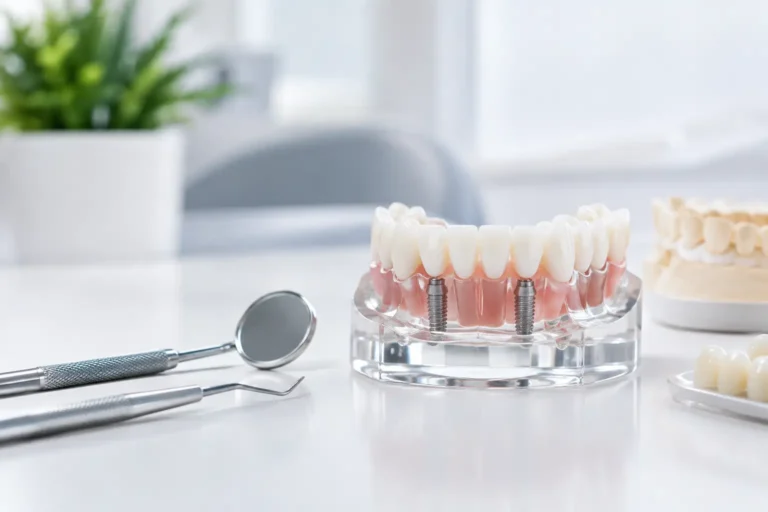
Replacing failing or missing teeth is not simply a matter of making a new crown, denture or bridge look attractive. It must also work comfortably within the way you bite, speak and chew. The benefits of specialist prosthodontic care become most apparent when treatment involves several teeth, dental implants, unstable dentures, or a full-mouth rehabilitation where every decision affects the next.
A prosthodontist is a dental specialist focused on restoring teeth and replacing missing teeth. This includes the planning and delivery of crowns, bridges, veneers, dentures and implant-supported teeth. For patients who have lived with loose dentures, repeated repairs, worn teeth or a failing dentition, that specialist perspective can make a meaningful difference to both the treatment process and the long-term result.
Why restoration needs more than a cosmetic solution
A smile can look convincing in photographs and still be uncomfortable to use. Teeth must meet in a controlled way, support the lips and face appropriately, allow clear speech and withstand the forces created during everyday eating. When one element is overlooked, problems may emerge later as chipping, loosening, jaw fatigue, food trapping or dissatisfaction with appearance.
This is especially relevant for patients considering All-on-Four, All-on-Six or All-on-X treatment. A fixed full arch is a carefully engineered restoration, not a standard product fitted to every mouth. Bone availability, gum contours, bite relationships, facial proportions, lip support and the condition of any remaining teeth all influence the design.
A specialist-led approach begins by establishing what is actually causing the difficulty. Sometimes the answer is a fixed implant solution. In other cases, a precisely made conventional denture, a partial denture, individual crowns or a more conservative treatment plan may be the better choice. The right option depends on clinical findings and the patient’s priorities, not on a pre-set recommendation.
The benefits of specialist prosthodontic care
Treatment is planned around the whole mouth
A single missing tooth can affect neighbouring teeth and the opposing bite. Multiple missing or worn teeth can alter facial support, reduce chewing efficiency and place excessive pressure on the teeth that remain. Planning each restoration in isolation may address an immediate concern without resolving the wider problem.
Specialist prosthodontic care considers the whole system. This means assessing tooth structure, existing restorations, gum condition, jaw relationships, tooth position and the space available for the final restoration. Where implants are being considered, the restorative outcome should guide their position. An implant placed without sufficient regard for the future crown or bridge may limit aesthetics, cleanability or function.
For full-arch treatment, this planning helps determine the appropriate tooth display, bite height and support for the lips and cheeks before definitive teeth are made. It also allows the final result to be discussed in practical terms rather than left to chance.
Bite function is given proper attention
Occlusion is the way the upper and lower teeth meet. It is one of the less visible parts of restorative dentistry, but it has a direct effect on comfort and longevity. A restoration that is fractionally too high, poorly shaped or not harmonised with the rest of the bite can be subjected to damaging forces.
For someone with extensive tooth wear, broken crowns or repeated bridge failures, the bite is often central to the problem. Restoring the teeth without addressing those forces may lead to a cycle of further repairs. A prosthodontic assessment examines how the jaws close and move, then designs restorations to distribute function as predictably as possible.
This does not mean every patient needs complex full-mouth work. Minimal intervention remains an important principle. The purpose of careful assessment is to identify when a focused restoration is enough and when a broader plan is necessary for a stable result.
Implant treatment is restoration-led
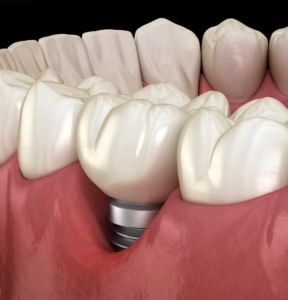
Dental implants are highly effective when they are placed and restored with disciplined planning. Yet an implant is only one component of the finished tooth replacement. The visible tooth, its emergence from the gum, the access for cleaning and the bite forces it receives all require equal attention.
For patients choosing fixed full-arch teeth, the position and angle of implants need to support a restoration that feels natural, is accessible for hygiene and is designed for the individual’s smile and facial proportions. Bone levels may influence what is possible, but the desired restorative result should remain central to decision-making.
At Maison Dentaire, premium internationally recognised implant systems, including Straumann and Megagen, are selected as part of a considered treatment plan. The system alone does not determine success. Accurate diagnosis, thoughtful prosthetic design, careful execution and ongoing maintenance are equally important.
Aesthetics are balanced with function
Natural-looking dentistry is rarely about creating the whitest or most uniform teeth possible. It is about proportion, texture, translucency, tooth shape and how the teeth relate to the lips, gums and face. A beautiful result should look appropriate for the person wearing it and feel comfortable in daily life.
This balance is particularly valuable with veneers, crowns and smile makeovers. Increasing length or changing the shape of front teeth can improve appearance, but it must be done with enough tooth support and a bite design that protects the restoration. In some situations, a conservative adjustment or a limited number of restorations is preferable to treating every visible tooth.
Patients should also expect an honest discussion about limits. Gum position, tooth wear, facial asymmetry and existing bite conditions may affect what can safely be achieved. Clear explanations before treatment are more valuable than unrealistic promises afterwards.
The process allows for better decisions
Complex restorative care benefits from time. Before committing to treatment, patients may need diagnostic records, scans, photographs, impressions or digital planning, followed by a written plan explaining the recommended stages. This creates an opportunity to understand the choices, ask questions and consider the likely maintenance involved.
For example, fixed implant teeth can provide excellent stability and confidence when eating and speaking, but they still require thorough cleaning and review appointments. Conventional dentures do not involve surgery and may suit certain medical, anatomical or personal circumstances, but they can move during function and may not provide the same chewing stability. Neither option is automatically right for everyone.
Transparent planning also makes it easier to distinguish essential treatment from optional aesthetic refinements. Patients deserve to know what is necessary to restore health and function, what may improve appearance, and what can reasonably be phased over time.
Who may benefit most from a specialist assessment?
Specialist prosthodontic care is particularly worthwhile when there is more at stake than a straightforward repair. This may include patients with several missing teeth, failing bridges, severely worn or broken teeth, long-standing denture difficulties, or a need for a complete fixed arch solution.
It can also be valuable for those who have had repeated restorative work but remain uncomfortable with their bite or unhappy with the appearance of their teeth. Recurrent chipping, loose crowns, cracked teeth and difficulty chewing are not always isolated incidents. They can indicate that the overall restoration needs to be reviewed.
Patients travelling from elsewhere in the Klang Valley, or from overseas, should allow enough time for a proper consultation and planning process. High-quality restorative treatment should not be rushed simply to fit a short visit. Some procedures can be carefully coordinated, but the clinical sequence must protect the quality of the final result.
What to look for in a treatment plan
A good prosthodontic plan should feel specific to you. It should explain the diagnosis, the available options, the likely sequence of treatment, the type of restoration proposed and the care needed after completion. It should also address foreseeable compromises rather than presenting only the most favourable outcome.
Ask how your bite will be assessed, how the final appearance will be planned, who will personally provide the treatment and what reviews are expected after fitting. For implant-supported work, ask how the design will allow you to clean around the restoration. These are practical questions, and the answers matter long after the treatment is complete.
The aim is not to have the most treatment. It is to have the right treatment, planned with enough precision that you can eat, speak and smile with greater confidence for years to come.