
A missing tooth is rarely just a gap in a smile. It can change how you chew, affect speech, allow neighbouring teeth to move, and gradually alter the way your bite meets. The best options for missing teeth depend on far more than the number of teeth lost. The condition of your remaining teeth, gums, jawbone, bite, health history and expectations all need careful consideration before treatment is recommended.
For some people, a simple and conservative replacement is appropriate. For others, particularly those living with loose dentures or several failing teeth, a fixed full-arch implant solution can be life-changing. The right answer is the one that restores function and appearance while protecting your long-term oral health.
Best options for missing teeth: start with the right diagnosis
It is tempting to compare treatments by price or by whether they are fixed or removable. Those factors matter, but they do not tell the full story. A restoration that looks attractive but overloads the remaining teeth, ignores gum disease, or fails to account for clenching may not last as intended.
A proper assessment should examine the teeth that remain, the health and volume of the jawbone, gum condition, facial support, the way your jaws relate when you bite, and the amount of space available for a replacement. Digital scans and X-rays help with planning, particularly where implants are being considered.
This is why two patients with a similar-looking gap may receive different recommendations. A specialist prosthodontic plan considers the replacement tooth as part of the whole mouth, not as an isolated cosmetic repair.
Replacing one missing tooth
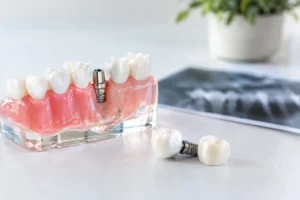
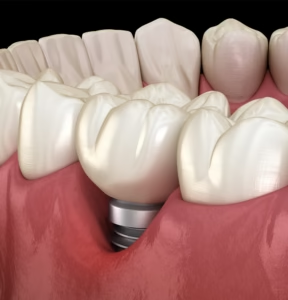
A dental implant and crown
For a single missing tooth, an implant-supported crown is often the closest replacement to a natural tooth. A small titanium implant is placed in the jawbone and, after suitable healing, supports a carefully designed crown. Unlike a bridge, it does not require the adjacent teeth to be filed down.
Implants can provide excellent stability, chewing comfort and a natural appearance when they are planned precisely. They also help preserve bone in the area of the missing root. However, implant treatment is not automatic. It requires healthy gums, sufficient bone or appropriate grafting, good home care and a commitment to review appointments. Healing time and cost are also greater than with some alternatives.
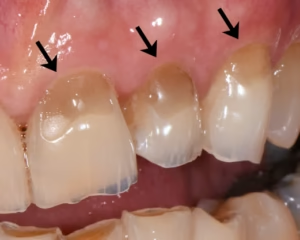
The crown should be designed around the bite, not simply matched by shade. This is particularly important for front teeth, where gum contours, tooth proportions and the way light passes through the ceramic all influence the final result.
A conventional dental bridge
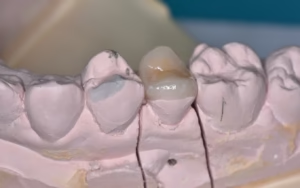
A bridge replaces a missing tooth by attaching a false tooth to crowns on one or both adjacent teeth. It can be a sensible option where those neighbouring teeth already need crowns because of extensive fillings, fractures or wear.
A well-made bridge is fixed and can restore appearance and function efficiently. Its main trade-off is that supporting teeth usually need preparation, and cleaning beneath the replacement tooth requires care. If one supporting tooth develops a problem later, the entire bridge may be affected.
A resin-bonded bridge
For selected cases, especially a missing front tooth, a resin-bonded bridge can be a more conservative solution. It is attached to the back of a neighbouring tooth with a discreet wing, often requiring little or no drilling.
This option can preserve healthy tooth structure and may be suitable for younger patients or those who are not ready for an implant. It is not ideal for every bite, particularly where there is heavy grinding or limited space. It can also debond over time, although it can often be reattached.
Replacing several missing teeth
When several teeth are absent, the decision becomes more involved. The goal is not simply to fill spaces but to create a stable bite that distributes chewing forces safely.
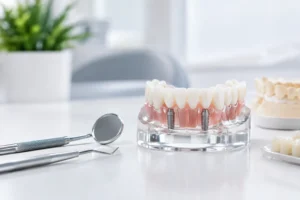
An implant-supported bridge may replace two or more missing teeth without placing an implant for every individual tooth. This can be a strong, fixed solution where bone and spacing allow. It avoids relying on natural teeth for support and is generally easier to keep stable than a removable partial denture.
A conventional bridge supported by natural teeth may still be appropriate where those teeth are strong, suitably positioned and already require restoration. The long-term prognosis of every supporting tooth should be assessed honestly. It is rarely wise to build an extensive bridge on teeth with advanced gum disease, repeated root canal problems or uncertain strength.
A removable partial denture is another option. Modern partial dentures can be made to look natural and are usually less costly initially than implants. They may be particularly helpful where many teeth are missing, surgery is unsuitable, or a patient needs a transitional replacement while healing or planning more definitive care.
The limitations are practical: partial dentures can move during eating, require removal for cleaning and may place pressure on gums or supporting teeth. A specialist-fitted denture should be designed with the bite, tissue support and appearance in mind, rather than treated as a generic appliance.
Full dentures and fixed full-arch implants
For patients missing all teeth in one or both jaws, or facing the loss of teeth that cannot be predictably saved, there are two broad pathways: conventional dentures and implant-supported full-arch rehabilitation.
Conventional full dentures
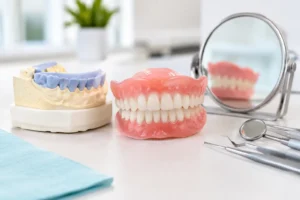
A full denture rests on the gums and is removable. It remains an appropriate treatment for many patients, particularly where medical considerations, bone volume, budget or personal preference make implants unsuitable.
A well-planned denture can restore facial support, speech and appearance. Yet lower dentures can be difficult to stabilise because the lower jaw provides less surface area for retention and is constantly influenced by the tongue and cheek muscles. Bone shrinkage over time may also cause dentures to loosen and require adjustment or replacement.
Denture quality varies considerably. The position of the teeth, the contours of the polished surfaces and the way the upper and lower dentures meet can make a meaningful difference to comfort and confidence.
Implant-retained dentures
An implant-retained denture remains removable but clips securely onto implants. It offers a significant improvement in stability compared with a conventional denture, particularly in the lower jaw. Patients often find it easier to eat and speak without worrying that the denture will lift or shift.
Because it is still removed for cleaning, it can be a practical middle ground between a conventional denture and fixed teeth. Attachments and the denture itself will need maintenance over time, so this should be included in the long-term plan.
All-on-Four, All-on-Six and All-on-X
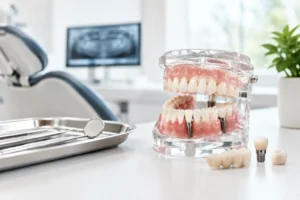
A fixed full-arch implant bridge replaces an entire upper or lower set of teeth using a planned number of implants. All-on-Four, All-on-Six and All-on-X describe the principle, but they are not interchangeable packages. The number, position and angle of implants should be selected according to available bone, bite forces, jaw anatomy and the design of the final teeth.
For the right patient, fixed full-arch treatment can provide a major improvement in stability, comfort and confidence. The teeth remain in place and are designed to function as a complete arch. This can be particularly valuable for patients who are exhausted by loose dentures or who have multiple damaged teeth with poor long-term prospects.
However, fixed does not mean maintenance-free. Implants and the bridge require meticulous cleaning, professional reviews and periodic maintenance. Some patients need bone grafting or preparatory treatment, while others may be suitable for carefully planned immediate provisional teeth. The final decision should be based on clinical evidence, not a promise that every patient can receive the same solution in a day.
How to choose the treatment that will serve you well
The most suitable option balances biological health, function, aesthetics, comfort and cost over time. It should also reflect your priorities. If avoiding removal of healthy tooth structure is most important, an implant or resin-bonded bridge may be preferable. If you need to replace a complete arch and want fixed teeth, full-arch implants may be worth considering. If surgery is not appropriate, a carefully constructed denture may be the soundest choice.
Ask what treatment is being proposed, why it suits your mouth, what alternatives exist and what maintenance will be needed. You should also understand the likely lifespan of each restoration, the risks to remaining teeth and gums, and how your bite will be managed. Clear written planning is valuable because it allows you to make a decision without pressure.
At Maison Dentaire, treatment planning is led personally by a specialist prosthodontist, with attention given to the appearance of the teeth, the health of the supporting tissues and the way the bite functions over time. That level of planning matters most when the work is extensive, but it is equally relevant when replacing a single tooth.
A missing tooth should not force a rushed decision. With an honest assessment and a restoration designed for your particular bite and goals, you can choose a solution that feels comfortable, looks believable and supports daily life with greater confidence.