
A lower denture that lifts while you speak, food trapped beneath an upper plate, or the need to avoid meals you once enjoyed can affect far more than eating. When considering implants versus removable dentures, the right choice is rarely about choosing the most advanced option on paper. It is about understanding what your mouth needs, what you want daily life to feel like, and which treatment can be planned predictably for the long term.
Both options can restore missing teeth attractively and functionally. However, they work in fundamentally different ways. A carefully made removable denture remains an appropriate solution for many people. Implant-supported teeth can offer greater stability and confidence, but they require sufficient planning, healing and investment. A specialist assessment should look beyond the number of missing teeth to consider your bone, gums, bite, health history and expectations.
Implants versus removable dentures: the fundamental difference
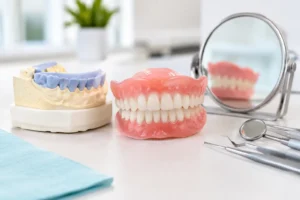
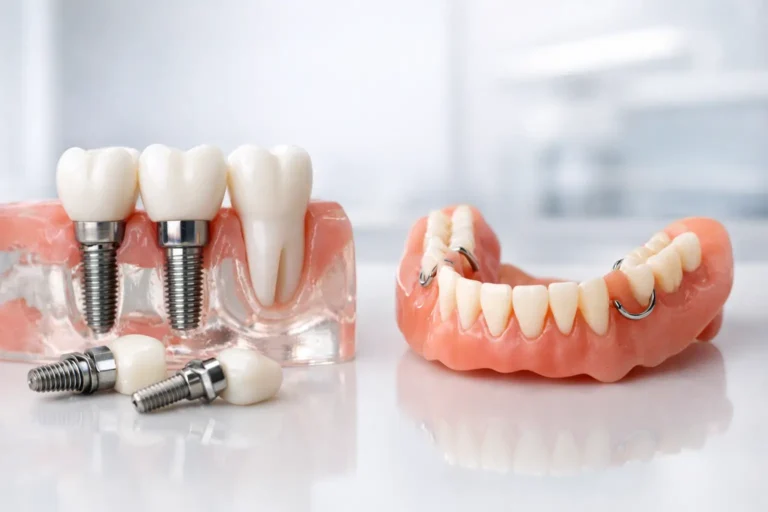
A removable denture sits on the gums and replaces missing teeth with an acrylic or, in some cases, metal-supported prosthesis. It may replace a full arch of teeth or only several missing teeth. It is taken out for cleaning and usually removed overnight.
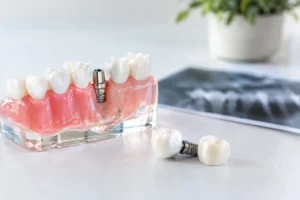
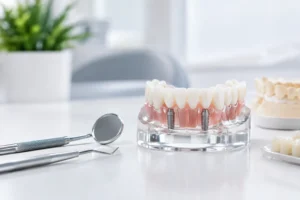
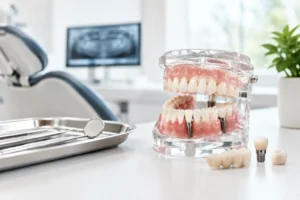
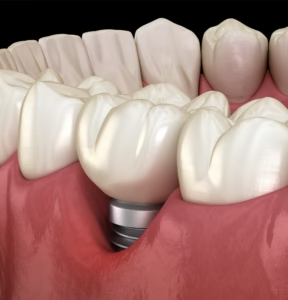
Dental implants are small titanium fixtures placed in the jawbone to act as artificial tooth roots. Once they have integrated with the bone, they can support a crown, bridge or a full fixed arch of teeth. For patients missing all teeth, treatments such as All-on-Four, All-on-Six or a personalised All-on-X plan use a strategic number of implants to support a fixed full-arch restoration.
The distinction matters because dentures rely largely on the shape of the gums, saliva and the surrounding tissues for retention. Implants derive their support from the jawbone. This changes how teeth feel when you chew, speak and smile.
What everyday comfort can look like
A well-designed denture should not be painful. Yet even a good denture can move slightly, especially in the lower jaw, where there is less surface area for support and the tongue is constantly active. Over time, natural bone changes after teeth are lost. As the ridge becomes smaller, a denture may become looser and require adjustment, relining or replacement.
Implant-supported teeth are generally more stable. A fixed implant bridge does not cover the palate in the way a conventional upper denture often does, which many patients find improves the sensation of food and their ability to taste it. Because the teeth are secured to implants, there is no need for denture adhesive and no concern about removing them before bed.
That said, fixed teeth are not automatically the best answer for every person. Some patients prefer a removable prosthesis because it is simpler to clean, less invasive or better suited to their budget and health circumstances. Others benefit from an implant-retained overdenture: a removable denture that clips securely onto implants. This can provide a substantial improvement in stability while keeping the restoration removable for cleaning.
Eating and speaking with confidence
Chewing efficiency with conventional dentures is lower than with natural teeth, particularly when the denture is loose or the gums are tender. Many denture wearers adapt by cutting food into smaller pieces, avoiding hard or fibrous foods, or chewing cautiously. These adjustments can be manageable, but they should not be dismissed when they are limiting nutrition or enjoyment of meals.
A fixed implant restoration usually allows more secure biting and chewing because it is anchored to the jaw. It can be particularly meaningful for patients who have struggled with lower dentures moving during meals. Speech may also feel more natural when a prosthesis is stable, although every new restoration requires a short period of adaptation.
The quality of the prosthesis is as important as the method of support. Teeth must be positioned carefully to support speech, facial appearance and a balanced bite. If a full-arch bridge is made too bulky, too long or poorly aligned with the opposing teeth, it may create discomfort despite being firmly attached. This is why detailed planning of the bite, known as occlusion, is central to long-term restorative care.
Bone preservation and facial support
When a tooth is lost, the jawbone in that area gradually remodels because it no longer receives stimulation from a tooth root. Dentures replace the visible teeth but do not replace the roots, so they do not prevent this process. Over many years, continued bone loss can affect denture fit and, in some cases, lip and facial support.
Implants transmit chewing forces into the bone and may help preserve bone around the implant site. They cannot recreate every aspect of the original jaw structure, and they do not stop all natural changes associated with ageing. However, preserving available bone is often a significant consideration, particularly for patients who have recently lost teeth or have been told that their remaining teeth are failing.
Where bone volume is limited, additional procedures may sometimes be needed before or alongside implant placement. In other situations, a carefully planned full-arch approach can make use of the available bone without extensive grafting. The suitable approach depends on three-dimensional scans, clinical examination and the intended final tooth position – not simply on a standard number of implants.
Comparing treatment time and commitment
Removable dentures can often be provided more quickly than implant treatment, particularly where teeth have already been missing and the gums are stable. They are also non-surgical. However, immediate dentures placed after extractions are usually a temporary stage, as the gums and bone change during healing. A definitive denture may be needed later for a more precise fit.
Implant treatment takes longer because it involves surgery, healing and the creation of a final restoration. Some full-arch cases can receive fixed provisional teeth soon after implant placement, provided the implants achieve suitable stability and the clinical situation permits it. This is not a promise that should be made without careful assessment. The final bridge is usually produced after healing and detailed refinement of the bite and appearance.
Good implant dentistry is therefore a process rather than a single appointment. It requires diligent home care, regular reviews and professional maintenance. Implants cannot develop decay, but the gums and bone around them can become inflamed if plaque is allowed to accumulate. Smoking, uncontrolled diabetes, heavy grinding and a history of gum disease can all influence risk and must be discussed openly.
Cost should be considered over the full lifespan of the restoration
A conventional denture has a lower initial cost than implant treatment. For some patients, that makes it the sensible and necessary choice. It can also be an excellent prosthesis when designed with care, reviewed regularly and supported by healthy tissues.
Implant-supported treatment has a higher initial investment because it includes surgical planning, implant components, laboratory work and the final restoration. In full-arch rehabilitation, the precision required to create a stable, natural-looking and maintainable bridge is substantial. Premium implant systems and specialist-led planning are intended to support predictable long-term care, not to add unnecessary complexity.
It is sensible to ask what is included in any proposed treatment plan. A clear written plan should explain the provisional stage, final prosthesis, follow-up appointments, maintenance needs and foreseeable future costs. The cheapest figure at the outset may not reflect the quality of materials, planning or aftercare required for a long-lasting result.
When removable dentures may be the better choice
Dentures are not a treatment of lesser value. They may be preferable where surgery is not medically appropriate, where bone or gum conditions make implants less predictable, or where a patient does not wish to undergo a surgical process. They can also be used as an interim solution while healing takes place or while a longer-term plan is considered.
For partial tooth loss, a removable partial denture may be a practical way to replace several teeth without altering healthy neighbouring teeth. In certain cases, it can be designed as part of a staged approach, allowing future implant treatment if circumstances change.
The key is to avoid accepting ongoing discomfort as inevitable. A denture that repeatedly rubs, clicks, lifts or prevents normal eating deserves a proper assessment. Often the answer may be an adjustment or a new denture, rather than implants. At other times, a small number of implants can transform the stability of an existing removable solution.
Choosing a solution that respects your whole mouth
The decision should not be made from an advertisement, an X-ray alone or a single price. Teeth are part of a system involving the jaw joints, muscles, gums, bone and the way your upper and lower teeth meet. This is especially relevant when multiple teeth are missing, when existing teeth are worn or loose, or when a patient has been wearing dentures for many years.
At Maison Dentaire, full-mouth and implant cases are planned with attention to function as well as appearance. A consultation should establish what can be saved, what must be replaced, whether implants are appropriate, and how the final teeth will be cleaned and maintained. A natural smile is valuable, but comfort, bite stability and long-term oral health are what allow it to remain enjoyable.
The most helpful next step is a calm, detailed consultation rather than a rushed decision. Once you understand the condition of your bone, gums and bite, you can choose teeth that suit not only your smile, but the way you want to eat, speak and live each day.