Losing every tooth, or facing a mouthful of teeth that are painful, loose or beyond repair, changes far more than a smile. Eating becomes restricted, speech can feel uncertain, and many people begin to avoid photographs and social occasions. Understanding how to replace all teeth starts with recognising that there is no single treatment that suits everyone. The right choice must account for your bone, bite, health, lifestyle, expectations and the long-term result you want to maintain.
For some patients, a carefully made denture is the sensible answer. For others, fixed full-arch teeth supported by dental implants offer the stability and confidence they have missed for years. The key is a detailed assessment and a treatment plan designed around your mouth, rather than a standard package.
First, establish which teeth can be saved
When teeth are badly worn, infected, mobile or heavily restored, it can be tempting to remove everything and begin again. That is sometimes appropriate, but it should never be assumed. Natural teeth, where predictably treatable, remain valuable.
A specialist assessment considers the health of each tooth, the level of gum and bone support, previous root canal treatment, decay, cracks and the way your teeth meet. Photographs, scans, X-rays and bite records help determine whether a staged approach, selective extractions or full-mouth rehabilitation is most appropriate.
If the remaining teeth cannot support comfortable and reliable function, replacing the full arch may prevent repeated emergency treatment and the ongoing frustration of failing dental work. The decision should be based on prognosis, not simply on how a tooth looks today.
How to replace all teeth: the main treatment options
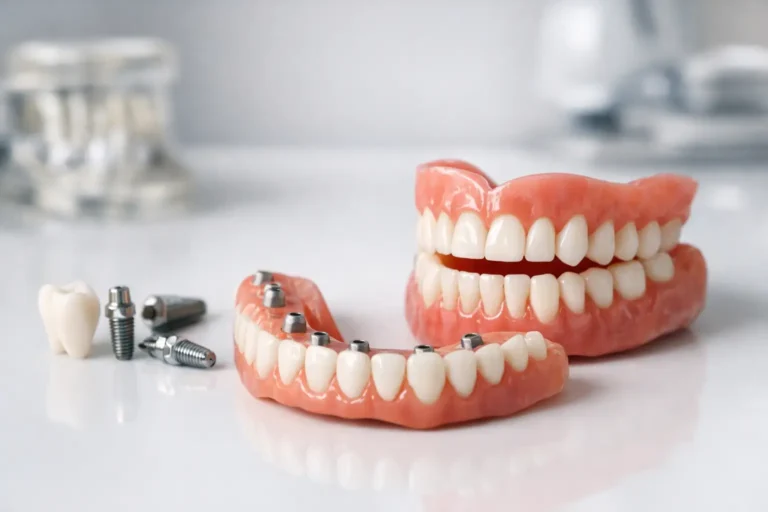
Full-mouth tooth replacement generally falls into two categories: removable teeth and implant-supported teeth. Both can be made to look natural, but they differ significantly in stability, feel, maintenance and cost.
Conventional full dentures
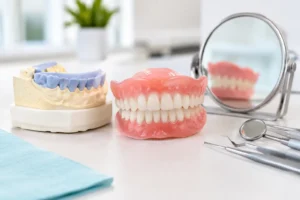
A full denture rests on the gums and replaces all the teeth in the upper or lower jaw. It can be an effective solution when implants are not suitable due to health considerations, limited bone, treatment preferences or budget.
A well-designed denture requires more than taking an impression. The teeth must be positioned to support the lips and face, the bite must be established carefully, and the base must fit the tissues accurately. This is particularly important for the lower jaw, where conventional dentures often move because there is less surface area for retention.
Dentures are removable for cleaning and should be reviewed over time. The jawbone naturally changes after tooth loss, so a denture may eventually need relining, adjustment or replacement. They can restore appearance and basic function very well, but they do not stop bone shrinkage in the way implants can.
Implant-retained removable dentures
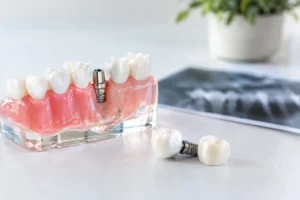
For patients who want more security without choosing a fixed full arch, implants can be used to hold a removable denture in place. Small attachments allow the denture to click onto the implants, reducing movement during eating and speaking.
This option is often especially helpful for a lower denture that lifts or rocks. It remains removable, so daily cleaning is straightforward, while the implants provide a meaningful improvement in stability. The number and position of implants depend on the jaw anatomy and the design of the final prosthesis.
Fixed full-arch implant teeth
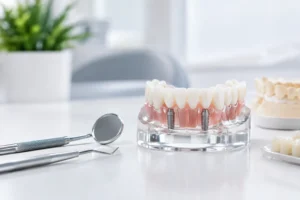
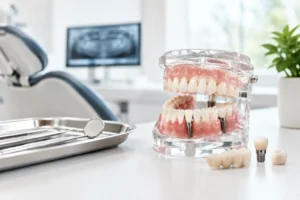
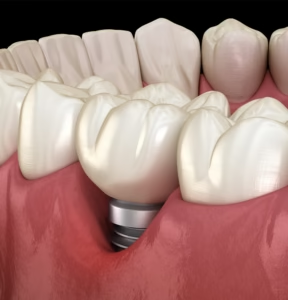
Fixed full-arch rehabilitation replaces an entire upper or lower set of teeth with a custom bridge secured to dental implants. It is commonly referred to as All-on-Four, All-on-Six or All-on-X. The number is not a marketing choice: it reflects the number of implants planned to support the final teeth.
All-on-Four may be suitable where bone volume is limited and carefully angled implants can avoid anatomical structures. All-on-Six or another implant configuration may provide a different distribution of support where anatomy and bite forces indicate it. More implants are not automatically better. The appropriate design depends on bone quality, jaw shape, clenching habits, opposing teeth and the final prosthetic plan.
Because the bridge is fixed, it does not cover the palate in the way an upper denture usually does. Many patients find this improves their ability to taste food and speak naturally. It also provides greater chewing stability than a conventional denture. However, fixed implant teeth still require daily cleaning underneath the bridge, professional maintenance and a commitment to protecting the investment.
The planning stage determines the long-term result
Full-arch treatment is not simply a surgical procedure followed by a set of teeth. It is a reconstruction of the bite, facial support and chewing function. Implant placement and the final prosthesis must be planned together from the beginning.
A thorough process commonly includes a clinical examination, digital scans, 3D imaging, photographs and an assessment of the jaw relationship. Your clinician will consider how much tooth should show when you smile, how the lips are supported, where the bite needs to sit and how forces will be distributed when you chew.
This is where specialist prosthodontic input is particularly valuable. The final teeth must be functional as well as attractive. A bridge that looks bright but has an unstable bite, poor cleansability or unsuitable proportions is unlikely to serve you well over time.
Some patients can receive provisional fixed teeth on the day implants are placed. This is often called immediate loading. It can be an excellent option, but it is not appropriate in every case. The implants need sufficient initial stability, and the temporary teeth must be designed to protect healing. Where bone grafting, infection, medical factors or bite forces make immediate loading less predictable, a staged approach may be safer.
What treatment feels like in practical terms
Most patients are understandably concerned about discomfort and whether they will be without teeth. Extractions and implant placement are carried out with local anaesthetic, with sedation options considered where appropriate. Recovery varies, particularly when multiple teeth are removed, but swelling and tenderness are usually most noticeable in the first few days.
A temporary denture or provisional fixed bridge may be used while healing takes place. During this period, a softer diet is normally necessary and the final bite is refined cautiously. Healing and integration of implants take time. Rushing to a definitive bridge before the tissues and bone are stable can compromise accuracy.
Once the final teeth are fitted, there is usually an adjustment period as you adapt to a new bite and speech pattern. This is normal. The goal is not merely to provide teeth quickly, but to create teeth that remain comfortable and dependable.
Costs, maintenance and the decisions that matter
The cost of replacing all teeth varies widely because the treatment is not one item. It may include extractions, scans, implant surgery, temporary teeth, bone grafting, sedation, laboratory work and the final prosthesis. A written plan should make clear what is included, what may change if unexpected findings arise, and what follow-up care is recommended.
It is sensible to compare more than the number of implants or the headline fee. Ask who plans the case, who places the implants, who designs and fits the final teeth, and what implant system will be used. Quality materials, experienced laboratory work and sufficient clinical time matter in a treatment that must withstand daily chewing forces for many years.
Long-term success also depends on maintenance. Implant bridges cannot decay, but the tissues around implants can develop inflammation if plaque is allowed to build up. Daily brushing, interdental cleaning designed for the bridge, regular hygiene visits and bite reviews are essential. If you clench or grind your teeth, a protective night guard may also be advised.
Choosing a solution that suits your life
The best answer may be a conventional denture, an implant-retained denture or fixed implant teeth. A patient with significant medical concerns may prefer the least invasive option. Someone who struggles with a loose lower denture may find two or more implants life-changing. A patient seeking the closest experience to natural teeth may be better suited to a carefully planned fixed full arch.
What matters is that the recommendation is clinically justified and explained clearly. At Maison Dentaire, full-mouth rehabilitation is planned with close attention to bite, facial appearance, materials and long-term maintenance, so patients understand both the benefits and responsibilities before treatment begins.
Replacing all teeth is a significant decision, but it does not have to be an overwhelming one. A calm, detailed consultation can turn a broad question into a clear plan – one that allows you to eat, speak and smile with greater comfort again.