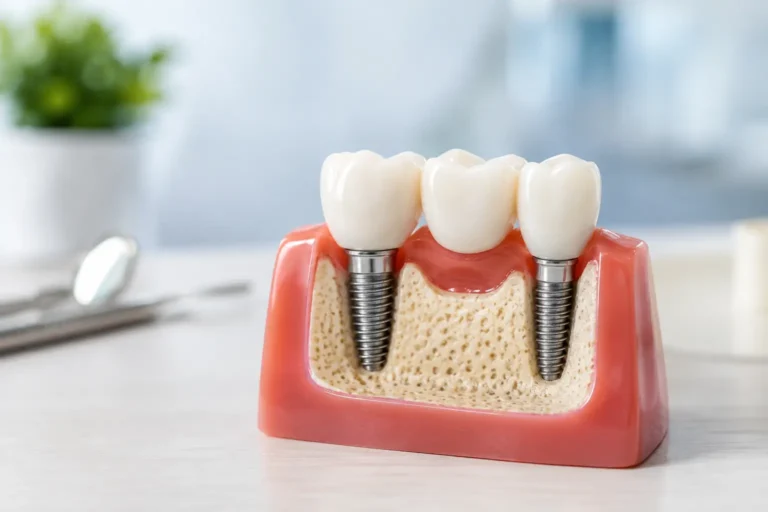
A useful implant bridge example is a patient who has lost three neighbouring teeth in the back of the mouth but still has healthy teeth on either side. Rather than filing down those healthy teeth for a conventional bridge, two dental implants can support a three-tooth fixed bridge. The result is a stable replacement that restores chewing function, appearance and confidence without relying on adjacent natural teeth.
This is a common treatment concept, but it is not a formula to apply to every gap. The number and position of implants, the bridge design, the condition of the bone and the way a patient bites all need careful assessment. A bridge that looks good on the day it is fitted must also be designed to cope with daily forces for years to come.
What an implant bridge is
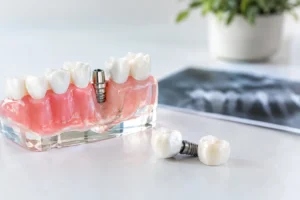
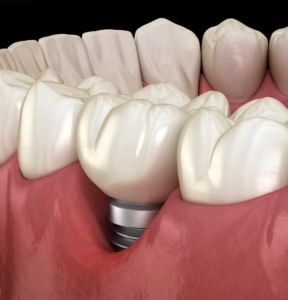
An implant bridge replaces two or more missing teeth using dental implants as its foundation. An implant is a precision-engineered titanium fixture placed in the jawbone, where it integrates with the bone over time. Once stable, it can support a custom-made crown or bridge.
Unlike a removable denture, an implant bridge is fixed in place. Unlike a conventional tooth-supported bridge, it does not require healthy neighbouring teeth to be shaped down for crowns. This conservative approach can be particularly valuable when the teeth beside the gap are sound and free from large fillings or existing crowns.
The visible bridge is made to match the surrounding teeth in shape, shade and surface texture. Beneath it, however, lies the more important part of treatment: a carefully planned implant position and bridge design that respects the gums, bone and bite.
Implant bridge example: three missing back teeth
Consider a patient missing the lower first premolar, second premolar and first molar on one side. These are working teeth, used heavily when chewing. The patient may have managed with the space for some time, but may now avoid tougher foods, chew mainly on the other side or feel that nearby teeth have begun to shift.
Following a detailed consultation, photographs, digital scans and three-dimensional imaging where indicated, the specialist assesses the available bone and identifies key structures in the jaw. The bite is also evaluated. This matters because a bridge placed in a high-pressure area needs a different level of planning from a single front tooth replacement.
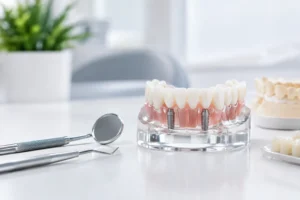
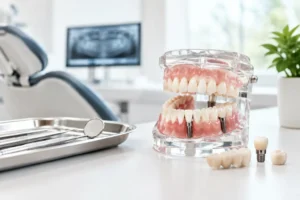
In a suitable case, two implants may be placed: one towards the front of the space and one towards the back. After healing and integration, a three-unit bridge is fitted over them. The bridge has three visible teeth, with the middle tooth supported by the bridge framework between the two implants.
This arrangement avoids placing an implant for every missing tooth where that is not clinically necessary. At the same time, it provides more support than a bridge carried by only one implant, which could be exposed to unfavourable leverage in a back-tooth region. The final decision depends on anatomy, bite forces, the length of the gap and the quality of the bone.
Why two implants can support three teeth
Teeth do not simply receive vertical chewing pressure. They also experience sideways forces during chewing and grinding. A well-designed implant bridge spreads these loads between the implants and limits excessive stress on the supporting components.
The bridge is therefore planned as a functional restoration, not merely a row of replacement teeth. Its width, contour and contact points are adjusted so that it feels natural to chew with while remaining cleansable. An overly bulky bridge may trap food; one made too narrow or too flat may not restore efficient chewing. Small details influence comfort and longevity.
The planning stage is where outcomes are decided
Patients often focus understandably on the final teeth. Yet the quality of an implant bridge is largely determined before surgery begins. Implant placement must be driven by the planned restoration, rather than placing implants first and attempting to make the bridge fit later.
A prosthodontist plans the position of each tooth in relation to the smile, facial features, gumline, opposing teeth and jaw movement. For back teeth, the emphasis is usually on restoring practical chewing ability and a stable bite. For front teeth, precise control of tooth position and gum support becomes especially critical.
Bone volume is another deciding factor. If bone has reduced after tooth loss, an implant may need a modified position, additional preparation or a different restorative approach. There is no benefit in forcing a standard bridge design into an anatomy that does not support it well. A transparent treatment plan should explain what is suitable, what compromises may be involved and why.
What treatment usually involves
Once planning is complete, the implants are placed with careful attention to their angle, depth and spacing. Some patients can receive a temporary tooth replacement during healing, while others are better served by allowing the area to heal without loading it immediately. The appropriate route depends on stability at placement, the location of the implants and the forces expected on the temporary restoration.
Over the following months, the implants integrate with the jawbone. During this period, good cleaning and follow-up reviews are essential. Smoking, uncontrolled medical conditions, untreated gum inflammation and heavy tooth grinding can all affect risk and may alter the recommended sequence of care.
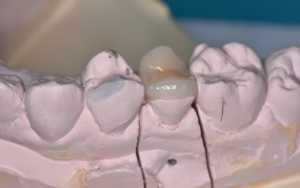
When the implants are ready, detailed impressions or digital scans are taken for the final bridge. The bridge is then tried in and refined. Its shade and shape are assessed, but so are the contacts between teeth and the way it meets the opposing arch. A bridge should not feel high, unstable or awkward when biting.
At Maison Dentaire, treatment is personally planned and delivered by a registered specialist prosthodontist, with attention given to the restoration as a whole: implant position, gum health, appearance and occlusion. Premium implant systems are selected where appropriate, but the system alone does not determine success. Diagnosis, planning and long-term maintenance remain central.
When this example may not be the right solution
A three-tooth implant bridge is not automatically the best answer for every three-tooth gap. If the space is short, bone is limited or access for cleaning would be poor, separate implants and crowns may sometimes be preferable. Conversely, if a larger section of teeth is missing, a longer bridge supported by several strategically placed implants may provide a more practical solution than placing one implant per tooth.
For a patient with failing teeth across an entire arch, treatment may move beyond a local bridge altogether. Full-arch implant rehabilitation can replace a complete upper or lower set of teeth with a fixed prosthesis supported by a planned number of implants. This is a different clinical situation, requiring detailed assessment of remaining teeth, bone, gum condition and bite relationship.
A conventional bridge or a removable partial denture may also remain appropriate in selected cases. The best treatment is not necessarily the most extensive one. It is the option that offers a sensible balance of health, function, aesthetics, maintenance and long-term predictability for that individual.
Living with an implant bridge
An implant bridge should be cleaned every day, including beneath the bridge where plaque can collect around the implant-supported teeth. Your clinician will demonstrate the appropriate brushes, flossing aids or water-cleaning devices for the design used. Regular professional reviews allow the gums, bite and restoration components to be checked before small issues become larger ones.
Implants cannot develop decay, but the gums and bone around them still require consistent care. A fixed bridge is a long-term restoration, not a fit-and-forget replacement. With thoughtful planning, careful fabrication and committed maintenance, it can feel remarkably close to having natural teeth again.
If you are considering treatment for several missing teeth, the most helpful next step is not choosing a bridge design from an illustration. It is having your bone, bite and restorative goals assessed carefully, so the solution is built around the mouth you have rather than an example alone.