
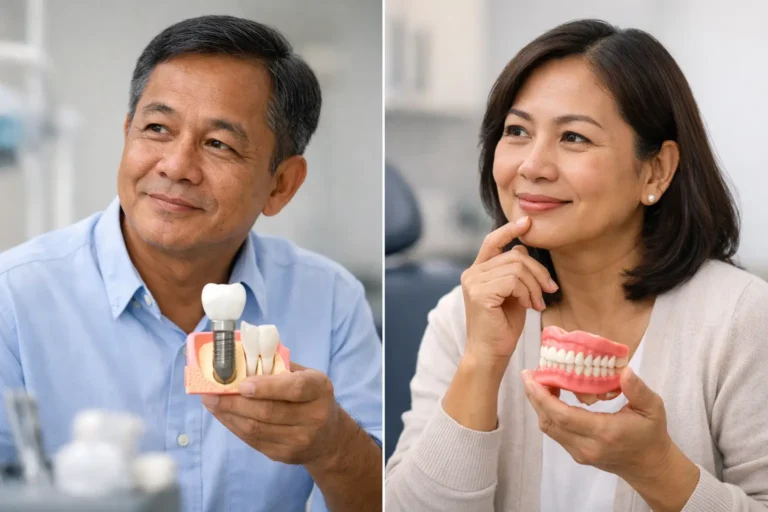
Losing teeth changes ordinary moments in ways people rarely expect. Meals become cautious, speech can feel less certain, and many patients start planning their day around what they can manage rather than what they want. When deciding between dental implants or dentures, the right answer is not simply the newest treatment or the cheapest one. It is the option that suits your oral health, expectations, lifestyle and long-term goals.
For some patients, a well-made denture is entirely appropriate and can restore appearance and basic function very effectively. For others, particularly those with multiple missing teeth or loose full dentures, implants offer a level of stability and confidence that removable teeth often cannot match. The key is careful assessment rather than assumptions.
Dental implants or dentures: what is the real difference?
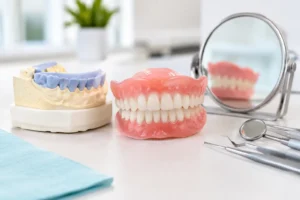
Dentures are removable prosthetic teeth designed to replace missing teeth and surrounding tissue. They can be full or partial, and they remain a valid treatment in modern dentistry. When properly designed and fitted, dentures can support facial appearance, improve speech and help with eating more comfortably than having no teeth at all.
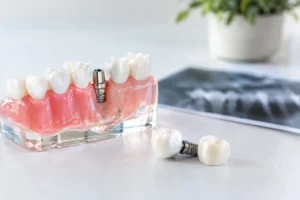
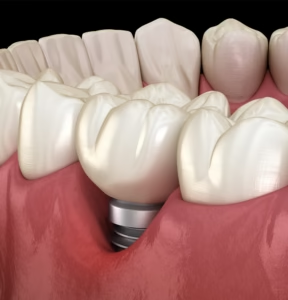
Dental implants are titanium fixtures placed into the jawbone to act as artificial tooth roots. They can support single crowns, bridges or full-arch restorations such as All-on-Four, All-on-Six or All-on-X. Unlike dentures, implants are anchored in bone, which gives them a much more secure feel.
That difference affects almost everything else – how you bite, how much movement you notice, how the jawbone responds over time and how natural your teeth feel day to day.
When dentures may be the right choice
Dentures are often a sensible option when a patient wants a lower initial cost, prefers to avoid surgery, or has medical and anatomical factors that make implant treatment less straightforward. They can also be a good short-term or transitional solution, especially if extractions are needed and the mouth is still healing.
A specialist-made denture is not the same as a quick, standardised appliance. The fit, bite relationship, tooth position and support for the lips and cheeks all matter. If those elements are carefully planned, dentures can look refined and natural rather than bulky or artificial.
That said, dentures do have limitations. Lower full dentures are often the most challenging because they tend to move more during speaking and chewing. Even upper dentures, which usually have better suction, may become less stable as the shape of the gums and bone changes over time. Many long-term denture wearers become accustomed to looseness, sore spots and reduced chewing ability, but that does not mean those problems are insignificant.
When implants may be the better long-term solution
If your priority is security, chewing power and a feeling closer to natural teeth, implants are often the stronger option. Because they are fixed into the jaw, they do not rely on suction or gum support in the same way dentures do. This usually means less movement, more confidence in social situations and a broader diet.
Implants can also help preserve the jawbone. After teeth are lost, the bone that once supported them begins to shrink. Dentures sit on top of the gums but do not stop this process. Implants, by contrast, transmit force into the bone and can help maintain it. This matters not only for oral health but also for long-term facial support.
For patients with failing teeth or no teeth at all, full-arch implant treatment can be life-changing. A fixed implant bridge can avoid many of the frustrations associated with removable dentures, especially when eating, laughing or speaking in public. However, implants are not automatically suitable for everyone. Good planning is essential, and the design must take account of bone levels, bite forces, smile line, medical history and maintenance needs.
Comfort, function and confidence
Most patients do not ask only about teeth. They ask whether they will be able to chew meat again, whether their denture will shift while talking, or whether anyone will notice the difference. These are the right questions.
Dentures can restore appearance well, but they usually provide less bite force than implants. Certain foods may still be difficult, particularly hard, fibrous or sticky foods. Some patients also notice a change in taste or speech, especially with upper dentures that cover the palate.
Implants generally perform better from a functional point of view. Because they are stable, patients can usually chew more effectively and speak with greater confidence. The psychological difference matters too. Fixed teeth tend to feel more secure because they are not removed at night and do not depend on adhesives.
Still, comfort is not only about whether a prosthesis moves. A poorly planned implant case can be difficult to clean or can place excessive force on certain areas. A denture that is expertly designed may be more comfortable than an implant solution that was chosen for the wrong reasons. This is why specialist assessment matters.
Cost is important, but so is value over time
Dentures usually cost less at the start. That makes them more accessible, and for some patients they are the most realistic choice. But lower upfront cost does not always mean better value over the years.
Dentures often need adjustments, relines or replacement as the mouth changes. If the denture becomes unstable, chewing efficiency and comfort can decline further. Over time, ongoing maintenance and the practical compromises of a removable appliance may become increasingly frustrating.
Implants involve a higher initial investment, especially for full-arch rehabilitation. However, many patients see that cost in the context of daily quality of life, durability and confidence. The right comparison is not simply price against price. It is what each option allows you to do, how long it is likely to serve you well, and what maintenance it will require.
Dental implants or dentures for full-arch tooth loss
If you have lost all teeth in one or both jaws, or your remaining teeth are no longer predictable, the decision becomes more specific. Conventional full dentures can replace a complete arch, but many patients struggle with movement, reduced bite strength and the need to remove them.
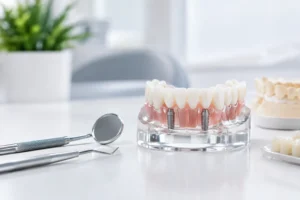
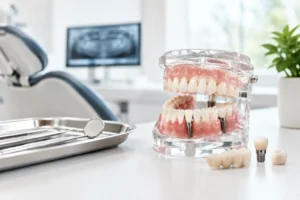
This is where implant-retained and implant-supported options become particularly relevant. Some patients choose implant-retained overdentures, which still remove for cleaning but clip securely onto implants for improved stability. Others prefer fixed full-arch bridges supported by implants, often planned as All-on-Four, All-on-Six or All-on-X treatment depending on bone availability and design requirements.
The right option depends on anatomy, expectations and budget. A removable denture on implants may provide an excellent middle ground for someone who wants more security without the cost of a fixed bridge. A fixed full-arch solution may suit someone who wants the closest experience to having teeth again and is prepared for the greater investment and planning involved.
What determines whether you are suitable for implants?
Suitability is about far more than wanting implants. Bone quantity and quality are important, but so are gum health, smoking habits, general health conditions, clenching or grinding, and how well you are likely to maintain the restorations.
The bite is especially important. In prosthodontic care, replacing teeth is not just about filling spaces. The forces across the whole mouth must be controlled so that the new teeth function well and last. This is one reason personalised treatment planning matters so much in complex restorative cases.
A careful consultation should assess not only whether implants can be placed, but whether they should be. In some cases, a denture is the wiser recommendation. In others, implants provide a far better long-term result. Neither choice should be pushed as a one-size-fits-all answer.
The role of specialist planning
Patients considering major tooth replacement are often comparing treatment types, but the more important comparison may be how the treatment is planned. A denture made without detailed attention to jaw relationships, appearance and support can disappoint quickly. An implant case done without proper prosthodontic planning can create long-term complications that are expensive and difficult to correct.
Specialist-led care brings the restorative outcome into focus from the beginning. That means evaluating aesthetics, bite function, cleaning access, material choice and longevity before treatment starts, not after problems appear. At Maison Dentaire, this approach is central to care for patients considering anything from a conventional denture to full-arch implant rehabilitation.
So which should you choose?
If you want a removable option with lower initial cost and no implant surgery, dentures may be entirely appropriate, especially when they are carefully designed and fitted. If you want greater stability, stronger chewing ability and a more fixed, natural feel, implants may offer clear advantages.
But the best decision usually comes from a more personal question: what problems are you trying to solve? If your current denture feels loose, if you avoid certain foods, if you feel self-conscious speaking, or if you are facing the loss of multiple teeth, then a tailored assessment can clarify which treatment genuinely fits your situation.
The right tooth replacement should not only fill gaps. It should restore comfort, function and confidence in a way that remains dependable long after the initial treatment is finished.