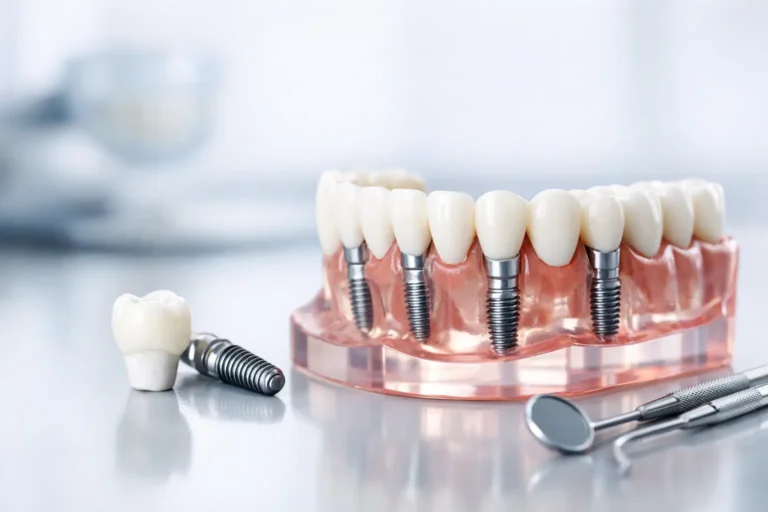
If you are looking in the mirror at failing teeth, or struggling with dentures that move when you eat or speak, the question is usually very direct: can you replace all teeth with implants? In many cases, yes – but not always in the same way, and not always with the same number of implants. The right answer depends on your bone support, bite, general health, expectations, and whether any remaining teeth can or should be saved.
For some patients, full-arch implant treatment is life-changing. It can restore chewing strength, improve speech, support the lips and cheeks more naturally than loose dentures, and remove the daily frustration of adhesives and slipping prostheses. However, replacing all teeth with implants is not a one-size-fits-all decision. It requires careful planning, especially when long-term function matters as much as appearance.
Can you replace all teeth with implants in one arch or both?
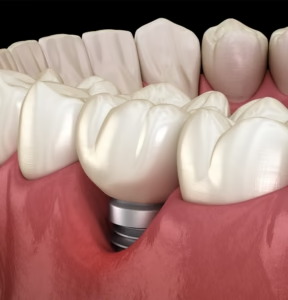
Yes, it is possible to replace all teeth in the upper arch, lower arch, or both using dental implants. What many patients do not realise is that this does not usually mean one implant for every missing tooth. In full-mouth rehabilitation, implants are commonly used as strategic anchors to support a fixed full-arch prosthesis.
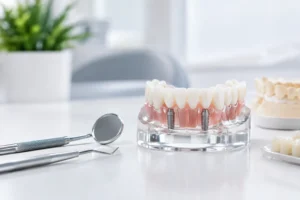
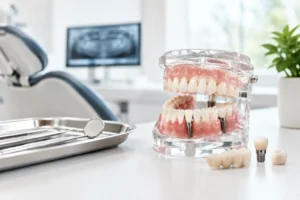
This is where terms such as All-on-4, All-on-6, and All-on-X come in. Rather than placing 14 implants to replace 14 teeth in one arch, a smaller number of carefully positioned implants can support a full set of fixed replacement teeth. The exact number depends on anatomy, bone volume, bite force, smile line, and the design of the final prosthesis.
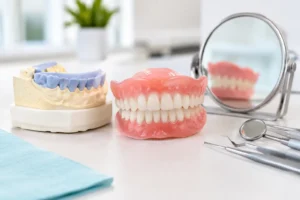
For some patients, a removable implant-retained denture is also an option. This uses implants for added stability but still allows the denture to be removed for cleaning. It is often more secure than a conventional denture, though it does not feel the same as a fixed bridge.
What are the main ways to replace all teeth with implants?
The treatment route depends on what is clinically appropriate, not simply what is most heavily advertised.
Full-arch fixed implant bridge
This is the option many patients have in mind when they ask whether all teeth can be replaced with implants. A full-arch bridge is attached to multiple implants and remains fixed in place. It is designed to look and function like a set of teeth, with careful attention to bite, support, phonetics, and cleansability.
For patients who want a non-removable solution, this is often the preferred approach. It can provide excellent stability and a strong sense of confidence in daily life.
Implant-retained overdenture
This option uses implants to hold a removable denture more securely. It is still taken out for cleaning, but it tends to feel firmer than a conventional denture and can improve comfort significantly. For some patients with budget limits, reduced bone volume, or specific hygiene concerns, this may be a sensible and effective choice.
Individual implants for each tooth
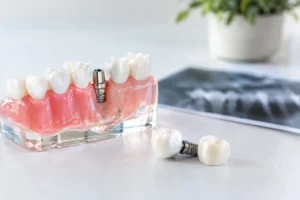
In theory, every tooth can be replaced with its own implant. In practice, this is rarely necessary for a completely edentulous arch. It often involves more surgery, more cost, and not necessarily a better result. In full-arch cases, the goal is not to place the highest number of implants. The goal is to create a restoration that is stable, functional, aesthetic, and maintainable over time.
Who is suitable for full-mouth implants?
Suitability is determined by diagnosis, not desire alone. Many adults with multiple missing teeth, advanced tooth wear, severe gum disease, failing bridges, or dentures are potential candidates. Even patients who have been told they have “no bone” may still have options, although treatment may be more complex.
The main factors your prosthodontist or implant dentist will assess include bone quantity and quality, gum health, medical history, smoking habits, grinding or clenching, and the position of the jaws. A CBCT scan is often used to examine bone in three dimensions and plan implant placement accurately.
General health matters too. Conditions such as poorly controlled diabetes, certain medications, or a history of head and neck radiotherapy may affect healing or risk. These do not automatically rule treatment out, but they do need careful review.
Then there is the question of expectation. Some patients want the shortest route to fixed teeth. Others want the strongest possible long-term solution, even if it means staged treatment, bone grafting, or a longer healing process. Neither approach is wrong, but they are not the same.
What if you do not have enough bone?
A lack of bone does not always mean implants are impossible. It means treatment planning becomes more important.
In some cases, angled implants can avoid anatomical limitations and support a full-arch bridge without extensive grafting. This is one reason All-on-X concepts can be so effective for selected patients. In other cases, bone grafting, sinus augmentation, or soft tissue management may be recommended to create a more predictable foundation.
There is always a trade-off. Avoiding grafting may shorten treatment and reduce surgery, but it may also limit implant positions or prosthetic design. Grafting may expand your options, but it adds time, healing, and cost. The right choice depends on your anatomy and on what you want the final result to achieve.
Are implants better than dentures for replacing all teeth?
For many patients, implants offer clear advantages over conventional dentures. A fixed implant prosthesis is generally more stable, more comfortable, and more efficient for chewing. It can also reduce the worry that the teeth will shift when talking or laughing.
That said, dentures still have a place. They can be appropriate for patients who are not suitable for implants, prefer a non-surgical option, or want a lower-cost treatment route. A well-made denture from a clinician who understands jaw relationships, support, and aesthetics can still perform well.
The key difference is that implants anchor the restoration to the jaw, whereas dentures rely on the gums and underlying bone for support. Over time, denture wearers often experience bone shrinkage, which can make fit progressively worse. Implants can help preserve bone and maintain stability, but they also require surgery, regular maintenance, and investment.
How long does treatment take?
There is no single timeline that fits everyone. Some patients can have failing teeth removed, implants placed, and a fixed provisional bridge fitted within a short period. Others need a staged approach with healing between phases.
If extractions are straightforward and bone is favourable, immediate implant placement may be possible. If there is active infection, severe bone loss, or a complex bite problem, it may be safer to phase treatment. The final definitive prosthesis is usually provided after a healing period, once the implants have integrated and the bite can be refined properly.
This is one area where careful, specialist-led planning matters. Fast treatment is appealing, but the speed of treatment should never outrun the biology.
What does full-mouth implant treatment cost?
This varies widely depending on the number of arches treated, the number of implants, the need for extractions or grafting, the material used for the bridge, and the complexity of the bite. A lower quote may not include the same prosthesis design, the same level of planning, or the same aftercare.
When patients compare fees, it helps to ask what is actually included. Is the clinician personally planning the case? Are provisional teeth included? What implant system is being used? Is there a written treatment plan? What happens if adjustments are needed after fitting?
For full-arch rehabilitation, the cheapest option can become expensive if it fails biomechanically or aesthetically. Precision in diagnosis, implant positioning, occlusion, and prosthetic design is what supports longevity.
What are the risks and limitations?
Implants have high success rates, but they are not risk-free. Implants can fail to integrate, components can loosen or fracture, and gum inflammation around implants can develop if hygiene is poor. Heavy grinding can place excessive stress on the restoration. Some patients also need time to adapt to changes in speech or bite.
There are practical limitations too. A fixed full-arch bridge does not behave exactly like natural teeth. It should feel secure and look natural, but it still needs professional review and disciplined home care. In some cases, a patient may want a fixed result but be better served by an implant-retained removable option for hygiene or anatomical reasons.
This is why careful case selection matters. The best treatment is not the one that sounds most dramatic. It is the one that gives you the best balance of comfort, function, appearance, and long-term maintainability.
What should you ask at a consultation?
If you are considering whether you can replace all teeth with implants, ask how many implants are recommended and why. Ask whether the restoration will be fixed or removable, what material is planned, whether bone grafting is needed, how your bite will be managed, and what maintenance will be required afterwards.
You should also ask who is planning and delivering the treatment. In complex full-arch cases, details matter. The position of the teeth, the support of the lips, the smile line, the chewing forces, and the cleansability of the prosthesis all influence the long-term result. This is where specialist prosthodontic planning can make a meaningful difference.
At Maison Dentaire, this type of treatment is planned with close attention to aesthetics, bite function, and durability rather than a standardised formula. That matters when you are replacing not just teeth, but confidence in how you eat, speak, and live each day.
If you are weighing implants against dentures, or trying to decide whether your remaining teeth are worth saving, the most useful next step is not a sales pitch. It is a careful diagnosis, a clear treatment plan, and an honest conversation about what will serve you best over the long term.