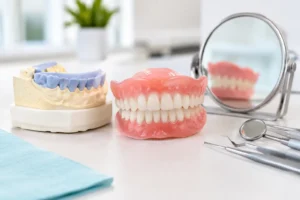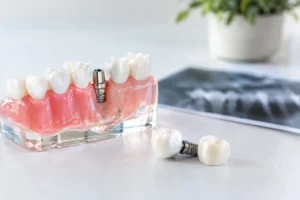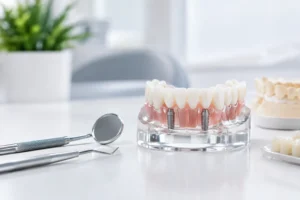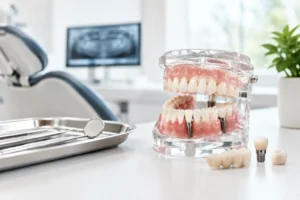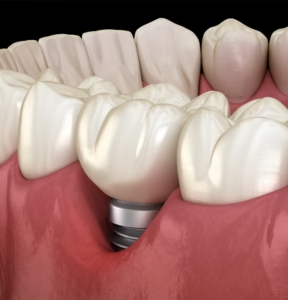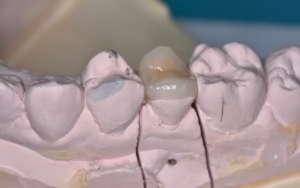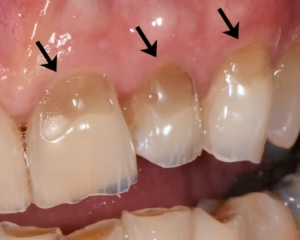


When you are considering implant treatment, the question is not simply whether implants are possible. The more important question is who should plan them. A specialist prosthodontist for dental implants focuses on how replacement teeth will look, feel, function and last over time, rather than treating the implant as a standalone fixture in the jaw.
That distinction matters most when teeth are missing in visible areas, when the bite has changed, when dentures have become unstable, or when several failing teeth may need to be replaced together. In these situations, success is not just about placing metal into bone. It is about designing a restoration that works in harmony with your face, gums, jaw joints and chewing pattern.
Why see a specialist prosthodontist for dental implants?
A prosthodontist is a dentist with advanced specialist training in restoring and replacing teeth. That training centres on crowns, bridges, dentures, full-mouth rehabilitation and implant restorations, with particular attention to bite function and aesthetics. For patients, this means the planning starts with the final teeth rather than the hardware alone.
This is especially relevant in implant cases because the visible result is what you live with every day. You do not chew with the implant screw. You chew with the crown, bridge or full-arch prosthesis attached to it. If the shape, bite, position or material is poorly planned, problems can follow even if the implant itself integrates well.
A specialist approach is therefore more comprehensive. It considers tooth proportions, smile line, lip support, speech, gum levels, load distribution and cleanability. In straightforward single-tooth cases this can improve the naturalness of the result. In complex cases such as All-on-Four, All-on-Six or All-on-X, it is often central to whether treatment feels stable and comfortable in the long term.
Dental implants are not one-size-fits-all
Patients are often told that implants are a permanent solution, but permanence depends on planning, maintenance and case selection. Some people need only one implant and crown. Others need a bridge supported by implants. Others are deciding between removable dentures and a fixed full-arch option. These are very different clinical situations, and the right treatment depends on anatomy, oral health, habits and expectations.
A patient who has worn loose dentures for years may need more than improved retention. They may also need facial support, a revised bite position and careful management of bone loss. Someone with cracked, heavily filled teeth may technically qualify for multiple individual implants, but a more conservative staged approach may be wiser. A person seeking a smile makeover may place equal importance on natural appearance and phonetics.
This is where specialist-led planning adds value. It allows the treatment recommendation to be built around the patient rather than around a standard package.
What a specialist prosthodontist looks at before implant treatment
Good implant treatment starts long before any surgical appointment. The diagnostic phase should be detailed and unhurried because it shapes every decision that follows.
Bite and jaw relationship
Your bite is not just about whether the teeth touch. It affects chewing efficiency, muscle comfort, wear patterns and the forces placed on restorations. If the bite is unstable, implant restorations can be overloaded. A prosthodontist assesses how the upper and lower teeth meet, whether the jaw position is repeatable, and whether there are signs of grinding or clenching.
Aesthetics and facial support
Missing teeth do not only leave gaps. They can alter lip support, smile width and facial proportions. In full-arch cases, this becomes particularly important because the prosthesis may need to restore not just teeth but also lost volume in the supporting structures. The aim is a result that looks credible, not artificial or bulky.
Gum contours and cleanability
An implant restoration must be maintainable. If the design traps food or is difficult to clean, inflammation and long-term complications become more likely. A specialist prosthodontist considers the contour of the final prosthesis and the surrounding soft tissue from the outset.
The condition of remaining teeth
Not every compromised tooth should be removed, and not every tooth can be predictably saved. The decision requires judgement. There are cases where preserving strategic natural teeth is beneficial, and others where retaining failing teeth delays more stable rehabilitation. This balance is one of the most important parts of treatment planning.
Single implants and full-arch implants require different thinking
A single front tooth implant can be one of the most technically demanding treatments in dentistry because even small aesthetic discrepancies are obvious. Matching adjacent teeth, gum symmetry and translucency takes meticulous planning. The best result usually comes from working backwards from the ideal visible tooth position.
By contrast, full-arch implant treatment is less about matching one tooth and more about rebuilding an entire system. Patients researching All-on-Four, All-on-Six or All-on-X are usually trying to solve bigger problems: loose dentures, multiple failing teeth, difficulty chewing, embarrassment when speaking, or repeated patchwork dentistry that no longer makes sense.
In these cases, the discussion should go beyond the number of implants. More implants are not automatically better, and fewer implants are not automatically inferior. It depends on bone availability, arch shape, bite force, prosthesis design, hygiene access and whether the treatment is intended as an immediate or staged solution. A specialist prosthodontist helps interpret these trade-offs properly instead of reducing the decision to marketing terms.
The value of specialist-led implant planning
Many patients assume the implant surgery is the main event. In reality, the quality of the final restoration and the planning behind it often determine whether treatment feels successful years later.
Starting with the end result
Specialist prosthodontic planning begins with the question: what should the final teeth achieve? From there, decisions can be made about implant positions, restorative materials, temporary teeth, gum management and whether any preparatory treatment is needed.
Personalised, not volume-driven
Standardised recommendations can miss important details. Some patients need a fixed full-arch bridge for confidence and function. Others may be better served by a well-made removable prosthesis, particularly if health, dexterity or maintenance concerns make a fixed option less suitable. Good care is not about selling the most extensive treatment. It is about recommending what is necessary and predictable.
Long-term function, not quick cosmetic appeal
Implants should look good, but they must also cope with daily function. That means considering occlusion, loading, wear, parafunction and material choice. A result that photographs well but chips, loosens or strains the bite is not a success.
What patients should ask before committing
If you are comparing providers, ask who is responsible for planning the final teeth, not just who places the implant. Ask whether your bite is being assessed, what the long-term maintenance involves, and how decisions are made if you have several failing teeth. Ask to see whether the treatment plan is tailored or generic.
You should also ask what alternatives exist. A trustworthy clinician will explain when implants are advisable, when they are optional and when another approach may be more sensible. That conversation is often where confidence is built.
For patients considering treatment in Kuala Lumpur, this level of specialist oversight can make a real difference in more complex restorative cases. At Maison Dentaire, implant treatment is planned and delivered with close attention to bite, aesthetics and long-term oral health, especially for patients moving from dentures or failing teeth to full-arch rehabilitation.
When specialist care matters most
Any implant case can benefit from careful restorative planning, but specialist input becomes particularly valuable when you have advanced tooth wear, multiple missing teeth, repeated bridge failures, long-term denture use, collapsing bite, or high aesthetic demands. These are not cases to approach casually.
The right treatment should leave you able to eat comfortably, speak naturally and smile without thinking about your teeth. It should also make sense biologically and mechanically, so that the result is easier to maintain and more likely to age well.
Choosing implant treatment is a significant decision. Choosing the right clinician is just as significant. If your case involves more than replacing a single uncomplicated tooth, it is worth seeking a plan built around precision, function and restraint – because the best dentistry is rarely the most aggressive option, but the one most carefully thought through.