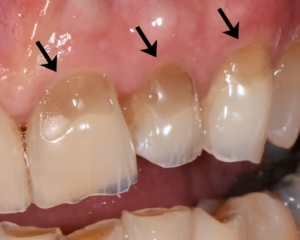

A photograph can make you notice what the mirror has allowed you to overlook: uneven edges, darkened teeth, old fillings showing through, or a smile that no longer feels like your own. A smile makeover with veneers can improve these concerns decisively, but it should never be approached as a simple cosmetic purchase. Veneers become part of your teeth, your bite and your daily life. The quality of the result depends as much on planning and precision as it does on the porcelain itself.
What a smile makeover with veneers can achieve
Veneers are fine, custom-made shells, usually crafted from porcelain, that are bonded to the front surface of selected teeth. They can change the visible colour, shape, length and proportion of teeth while preserving more natural tooth structure than a full crown in appropriate cases.
For some patients, the concern is subtle: a small gap, worn front teeth or enamel that has become uneven over time. For others, the starting point is more complex, involving previous bonding, discoloured restorations, chips, crowding or a smile that appears too short when speaking. Veneers can create a more harmonious appearance, but the objective is not to produce identical, overly bright teeth. It is to create a smile that suits your facial features, age, lip movement and character.
A well-planned result should look convincing at conversational distance and remain comfortable when you bite, chew and speak. That is why aesthetic treatment must be assessed alongside function.
Veneers are not the answer to every cosmetic concern
Veneers are highly versatile, but they are not automatically the most conservative or sensible treatment. If the main issue is tooth colour and the enamel is healthy, professional whitening may be sufficient. Minor chips or small gaps may be corrected with composite bonding. If teeth are significantly crowded, orthodontic treatment may protect more tooth structure than reshaping several teeth for veneers.
Equally, a tooth with a large old filling, extensive decay or a previous root canal may need a crown rather than a veneer. Patients who have lost teeth, have loose teeth or are experiencing widespread breakdown need a broader restorative assessment before cosmetic treatment is considered. In these situations, addressing gum health, tooth stability and bite support comes first.
This is where a specialist prosthodontic approach matters. The right recommendation is not necessarily the treatment that changes the most teeth. It is the treatment that provides the most appropriate long-term result with the least unnecessary intervention.
Why bite planning matters as much as appearance
The front teeth do more than show when you smile. They guide the jaw during certain movements and receive considerable force when biting into food. If veneers are designed without careful attention to this relationship, they may chip, debond, feel bulky or contribute to discomfort in the jaw and surrounding teeth.
A detailed assessment considers how the upper and lower teeth meet, whether there is existing tooth wear, and whether you clench or grind. It also looks at the gums, the condition of the enamel, the position of the teeth and the amount of tooth display at rest and when smiling. These details determine whether veneers are appropriate, how much preparation is needed and which teeth should be included.
Patients sometimes ask for veneers only on the most visible teeth. This can work well, particularly where the remaining teeth are healthy and well matched. However, the number of veneers required depends on smile width, existing shade, tooth proportions and the desired change. A natural result often requires consideration of how the treated teeth blend with adjacent teeth, not simply how they look in isolation.
Minimal preparation is a principle, not a promise
Modern porcelain veneers can be extremely thin. In selected cases, this allows very minimal enamel preparation or, occasionally, no preparation at all. Yet “no-prep veneers” are not automatically better. If porcelain is placed over teeth without adequate space, the teeth may look prominent or the contours may be difficult to clean.
Conversely, removing too much healthy enamel simply to create a dramatic change is not a responsible approach. The amount of preparation should be determined by the existing tooth position, the thickness and colour of the material required, and the planned final contours. Wherever possible, preserving enamel is valuable because bonding to enamel is predictable and durable.
The planning process before veneers are placed
A smile makeover should begin with a consultation rather than a treatment package. The first appointment is an opportunity to understand what you would like to improve, what you are unhappy with and what you would prefer to keep. Some patients want a brighter, more youthful smile; others want to retain individual character while correcting wear or asymmetry.
Clinical records are then used to plan accurately. These may include photographs, digital scans, X-rays where indicated and an assessment of your bite. From this information, the proposed shape, length and position of the teeth can be evaluated before irreversible treatment begins.
A diagnostic mock-up or trial smile can be especially helpful for more significant changes. It allows the proposed design to be reviewed in the mouth, rather than judged from a photograph alone. You can assess how it looks with your lips, how it feels when speaking and whether the tooth length is appropriate. It also gives the clinician a precise guide for conservative preparation and the dental technician a clear blueprint for the final veneers.
At Maison Dentaire, veneer treatment is planned and delivered personally by a registered specialist prosthodontist. This matters because the same clinician who evaluates the bite, tooth structure and facial proportions remains responsible for the final restorative decisions.
Choosing shade and shape without creating an artificial smile
The brightest shade is rarely the best shade. Natural teeth have variation in translucency, texture and light reflection. High-quality porcelain can reproduce these qualities, but only if the design is guided by the patient’s complexion, age, neighbouring teeth and expectations.
Shape also changes the impression a smile creates. Longer edges can restore teeth worn down by years of use, while softer line angles may create a gentler appearance. Squarer teeth can look stronger, but may not suit every face. There is no universal template for an attractive smile.
Temporary veneers or a mock-up can provide a useful opportunity to discuss these choices. It is far easier to refine a proposed design before the final porcelain is made than after it has been bonded.
What treatment and recovery are usually like
Once the design is agreed, the teeth are prepared conservatively where needed and accurate impressions or digital scans are taken. Temporary veneers may be fitted while the final porcelain is crafted, particularly when several teeth are being altered or when preparation has been required.
At the fitting appointment, each veneer is tried in before final bonding. The clinician checks shade, shape, margins, contact points and bite. Bonding is a meticulous stage: the teeth and porcelain must be prepared carefully to achieve a secure, lasting attachment.
Most patients return to normal routines quickly. It is common for the bite to feel unfamiliar for a few days, particularly if tooth length or shape has changed. Any persistent pressure point, rough edge or discomfort should be reviewed promptly rather than ignored. A planned review also allows the gums, bite and finish to be checked once you have adapted.
Looking after porcelain veneers
Porcelain is stain resistant and strong, but veneers are not indestructible. They should be cared for in much the same way as natural teeth: brush twice daily with a non-abrasive toothpaste, clean between the teeth and attend regular professional reviews. Gum health remains essential because the gums frame the veneers and support the underlying teeth.
Avoid using veneered teeth to open packaging, bite fingernails or crack hard objects. If you grind or clench, a carefully fitted night guard may be advised to reduce the risk of damage. Veneers can last many years when they are well designed, well bonded and well maintained, but they may eventually need repair or replacement. This should be understood before treatment begins.
The best smile makeovers do not announce themselves. They allow you to speak, laugh and eat with ease, while looking recognisably like yourself. If veneers are being considered, take the time to have your teeth, gums and bite assessed properly. A calm, detailed plan is the foundation for a result that remains attractive long after the first reveal.