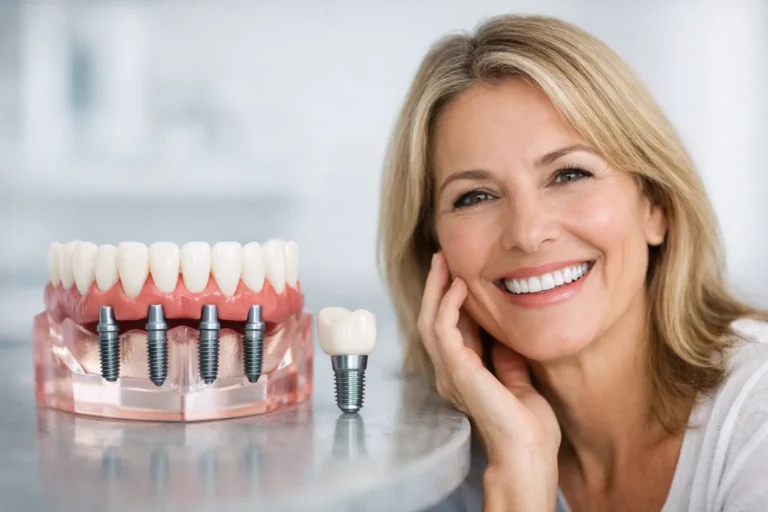
A denture that lifts while you speak or shifts when you eat is more than an inconvenience. It can change what you order at a restaurant, how freely you smile, and how confident you feel around other people. For patients with failing teeth or loose full dentures, all on 4 dental implants can provide a fixed full-arch solution designed to restore stability, appearance and chewing function.
The treatment is not simply about placing four implants and fitting new teeth. A successful result depends on careful diagnosis, implant positioning, bite design and a final bridge that suits your facial features and daily needs. It is a significant investment in your oral health, so it deserves specialist-led planning rather than a standardised recommendation.
What are all on 4 dental implants?
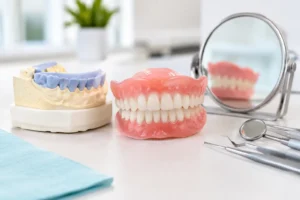
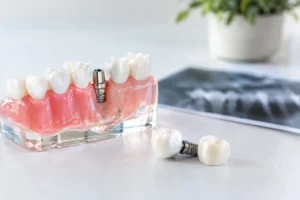
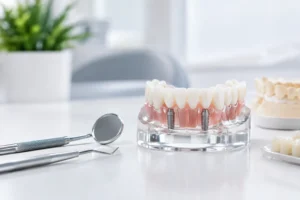
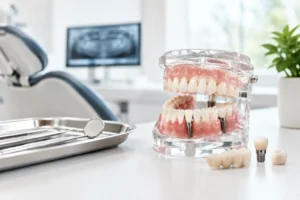
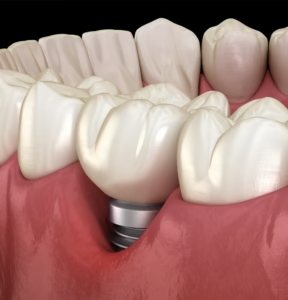
All on 4 dental implants is a full-arch rehabilitation approach in which four dental implants support a fixed bridge replacing an entire upper or lower arch of teeth. The bridge is securely attached to the implants and is only removed by the dental clinician for review or maintenance. Unlike a conventional denture, it does not rely on suction, adhesives or pressure against the gums for retention.
The front implants are usually placed vertically, while the implants towards the back may be angled. This can make better use of the available bone and may avoid anatomical structures such as the maxillary sinus in the upper jaw or the nerve canal in the lower jaw. In suitable cases, this approach can reduce or avoid the need for extensive bone grafting.
However, the term describes a treatment concept, not a guarantee that four implants are right for every patient. Some mouths are better served by All-on-Six or another All-on-X design, particularly where bone quality, bite forces, jaw anatomy or the planned bridge design call for additional support.
Who may be suitable for all on 4 dental implants?
This treatment is often considered by people who have lost all, or most, of the teeth in one jaw. It may also suit patients whose remaining teeth are severely worn, loose, infected or repeatedly failing and cannot be predictably maintained in the long term.
For many patients, the principal attraction is being able to eat and speak with greater confidence without removing their teeth at night. A fixed bridge can also provide better support for the lips and face than a poorly fitting denture, although the final appearance must be planned carefully. Natural-looking teeth are not created by selecting a bright shade alone. Tooth proportions, gum display, lip support and the way the teeth meet all matter.
Suitability depends on more than how many teeth are missing. Your clinician will assess the volume and density of jawbone, gum health, medical history, smoking or vaping habits, clenching and grinding, oral hygiene, and expectations for treatment. Conditions such as uncontrolled diabetes may affect healing. Heavy grinding may require a more protective bridge design and a night guard. These factors do not automatically rule out implant treatment, but they need to be addressed honestly before surgery.
Why planning matters as much as implant placement
The visible bridge is the part patients see, but the long-term result begins with the plan beneath it. Three-dimensional imaging allows the clinician to evaluate bone availability and identify vital structures. Records of your existing bite, facial proportions and smile line help determine where the teeth should sit – not merely where there is space to place implants.
This is particularly important when teeth are removed on the day of implant surgery. The aim is not only to replace what has been lost, but to establish a stable bite that distributes force appropriately. If the bridge is too bulky, difficult to clean or poorly positioned, it can compromise comfort, speech and maintenance. If the bite is not carefully controlled, excessive force can affect the bridge, screws, implants or surrounding bone.
At Maison Dentaire, full-arch treatment is personally planned and delivered by a specialist prosthodontist. This level of oversight is valuable because prosthodontic care considers the entire restorative result: the implants, the bridge, aesthetics, function and the way the teeth will be maintained over time.
The treatment journey
Consultation and diagnosis
The first appointment should be unhurried. It involves discussing what is troubling you now, whether teeth can be saved, and what you want to achieve with treatment. Clinical examination, photographs, digital scans and appropriate X-rays or three-dimensional imaging are used to build a clear picture of your oral condition.
You should receive a written treatment plan explaining the proposed approach, the stages involved, likely timeframes, alternatives and fees. In some cases, keeping selected natural teeth, using a removable denture, or planning a staged implant solution may be the more sensible option.
Surgery and provisional teeth
If teeth need to be removed, extractions and implant placement may sometimes be carried out in the same procedure. Where the implants achieve sufficient initial stability and the clinical situation is appropriate, a fixed provisional bridge may be fitted soon after surgery. This is often described as immediate loading.
Immediate teeth are not the same as final teeth. They are carefully designed to protect the healing implants while allowing you to function socially and comfortably. During this phase, a softer diet is usually required. Not every patient is suitable for immediate loading, and a responsible clinician will not promise it before the relevant records have been assessed.
Healing and the final bridge
Over the following months, bone integrates with the implant surfaces. Review appointments allow the clinician to monitor healing, adjust the provisional bridge where necessary and ensure that cleaning remains manageable.
Once the implants and gums are stable, the final bridge is made. This stage requires precision. The material, tooth shape, shade, bite and access for cleaning are selected for your individual case. A final bridge should feel secure and look harmonious, but it must also allow the patient to maintain healthy tissues around the implants.
Benefits and trade-offs to consider
For the right patient, all on 4 dental implants can offer meaningful improvements. The bridge is fixed, chewing is usually more efficient than with a loose conventional denture, and there is no palate-covering acrylic on an upper full-arch bridge. Many patients also value the psychological reassurance of having teeth that stay in place.
There are trade-offs. Implant treatment is surgical and requires a commitment to healing, review appointments and lifelong maintenance. It is also more costly than a conventional denture. While implants have high long-term success rates when properly planned and cared for, they are not maintenance-free and complications can occur.
Food debris can collect beneath a full-arch bridge, so daily cleaning with purpose-designed brushes, flossing aids or water irrigation is essential. Professional maintenance appointments are equally important. The bridge may need periodic adjustment, polishing, screw checks or repair as it ages. Patients who are unable or unwilling to maintain the area carefully may be better served by another option.
It is also worth asking whether four implants provide the most appropriate support for your case. More implants are not automatically better, but neither is choosing the fewest possible implants simply because the treatment has a familiar name. The correct number is the number that offers a sound balance of biology, function, bridge design and long-term prognosis.
Questions worth asking at your consultation
A full-arch consultation should leave you with clarity, not pressure. Ask who will plan and carry out each stage of treatment, whether your remaining teeth are genuinely unsalvageable, and why a four-, six- or alternative implant design has been recommended. You should also understand what provisional teeth are included, what the final bridge will be made from, and how ongoing maintenance will be managed.
It is sensible to ask about risks specific to your mouth, including bone grafting, sinus considerations, nerve proximity, gum disease, grinding and the possibility that the final plan may need to change after surgery. Transparent discussion is not a sign of uncertainty. It is a sign that treatment is being planned responsibly.
A well-designed full-arch restoration should give you more than a set of fixed teeth. It should give you a bite that is comfortable, a smile that feels like your own and a practical plan for keeping the result healthy for years to come.