Losing every tooth can affect far more than your smile. Meals become restricted, speech may feel less certain, and a loose denture can make everyday social situations unexpectedly stressful. If you are thinking, “I have no teeth left, what are my options?”, there is no single answer that suits everyone. The right choice depends on your bone support, gum health, medical history, bite, expectations and the level of stability you want in daily life.
The reassuring point is that complete tooth loss can be treated thoughtfully. Whether you prefer a well-made removable denture or are considering a fixed full-arch implant solution, the aim should be the same: teeth that look natural, allow you to eat and speak comfortably, and are planned for long-term health.
When You Have No Teeth Left, What Are Your Options?
There are three main approaches: conventional full dentures, implant-retained removable dentures, and fixed full-arch teeth supported by dental implants. Each has a valid place. The best option is not necessarily the most complex treatment, but the one that provides the right balance of function, comfort, maintenance and cost for you.
Before recommending any of these options, a prosthodontist will assess the shape and volume of your jawbone, the condition of your gums, the relationship between your upper and lower jaws, facial support, and how much space is available for the replacement teeth. A 3D scan is often needed to assess implant suitability accurately.
This planning matters. Full-mouth rehabilitation is not simply about placing teeth into the mouth. The teeth must be positioned to support speech, lip shape, chewing efficiency and a stable bite. An attractive result that is difficult to clean or poorly balanced can cause problems later.
Option 1: Conventional Full Dentures
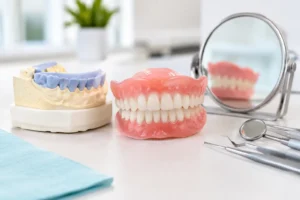
A full denture replaces all teeth in either the upper or lower jaw. It rests on the gums and is removable for cleaning. Modern dentures can be carefully designed to look natural, with tooth shape, shade and gum contours selected to suit your face.
For some patients, conventional dentures are the most sensible starting point. They do not require surgery, the treatment is generally more affordable than implant treatment, and they can restore appearance and basic function relatively quickly. They may also be appropriate where medical conditions make implant surgery unsuitable, or where bone and financial considerations make a removable solution preferable.
The trade-off is stability. Upper dentures often gain reasonable suction from the palate, although this varies between individuals. Lower dentures are usually more challenging because the tongue and movement of the floor of the mouth can dislodge them. Even a precisely fitted denture may move slightly when eating firmer foods.
Dentures also need regular review. The jawbone naturally changes after teeth are lost, particularly during the first years, so a denture may eventually require adjustment, relining or replacement. A poorly fitting denture should not simply be tolerated. Soreness, repeated movement and difficulty chewing are reasons to seek an assessment.
Option 2: Implant-Retained Overdentures
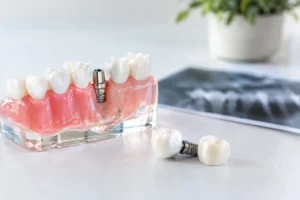
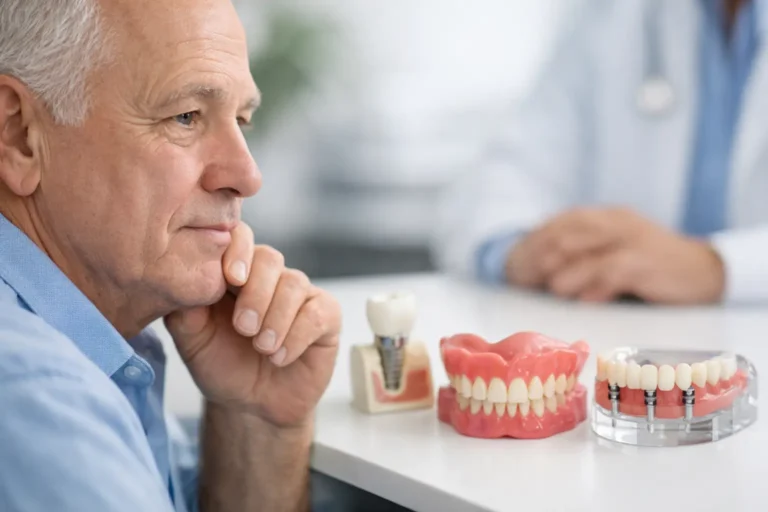
An implant-retained overdenture is still removable, but it clips or attaches to dental implants placed in the jaw. In the lower jaw, two implants can often provide a significant improvement in denture stability. More implants may be recommended depending on anatomy, bite force and the design of the final prosthesis.
This option can be a practical middle ground for patients who want greater confidence than a conventional denture offers but do not require a fixed bridge. The denture is removed at night for cleaning, while the implants help reduce rocking and lifting during meals and conversation.
An overdenture does require ongoing care. The attachment components wear over time and need maintenance, and both the denture and the implants must be cleaned diligently. It is not a lesser form of treatment when it is properly planned. For the right patient, it can deliver a meaningful improvement in comfort and quality of life without the cost and complexity of a fixed full arch.
Option 3: Fixed Full-Arch Dental Implants
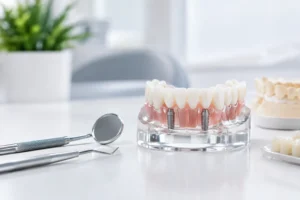
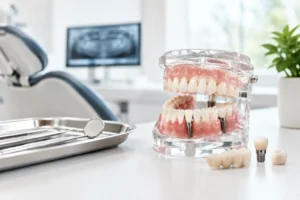
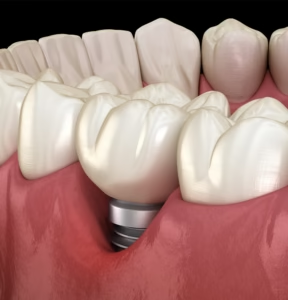
For patients seeking teeth that remain in place, a fixed implant bridge may be the preferred solution. Several implants are placed strategically in the jaw to support a complete arch of replacement teeth. The bridge is secured to the implants and is removed only by the dental team for professional maintenance when needed.
You may hear this described as All-on-Four, All-on-Six or All-on-X. These names refer broadly to the number of implants used to support a full arch. Four implants can be suitable in selected cases, while six or more may be advised where the bone, bite forces or long-term design call for additional support. The number should be determined by clinical needs, not by a standard package.
Fixed full-arch treatment can offer excellent stability. Patients often value being able to eat with greater confidence, speak without worrying about denture movement, and feel that their teeth are part of them again. It can also avoid covering the palate in the upper jaw, which some patients find improves their perception of food and comfort.
However, fixed does not mean maintenance-free. The bridge requires daily cleaning underneath, usually with specialised brushes and water cleaning devices. Regular professional reviews are essential to monitor the gums, implants, bite and condition of the bridge. Patients with a history of severe grinding may also need a protective night guard.
Immediate Teeth and Final Teeth Are Not Always the Same
In some cases, failing teeth can be removed, implants placed and a fixed temporary bridge fitted on the same day. This is often called immediate loading. It can be an excellent option, but it is not appropriate for every patient.
Immediate treatment depends on achieving sufficient implant stability, having an appropriate bite, and being able to follow a carefully controlled soft-food diet while healing takes place. The provisional bridge is designed to protect the healing implants. Your final bridge is made later, once the gums and bone have stabilised and the bite can be refined.
A promise of same-day fixed teeth without a full assessment should be approached carefully. Speed can be valuable, but predictable healing and accurate planning matter more.
What If There Is Not Enough Bone for Implants?
Bone loss is common after teeth have been missing for some time, but it does not automatically rule out implant treatment. A 3D scan allows the clinician to assess where bone is available and whether grafting, sinus procedures or angled implant placement may be appropriate.
In selected full-arch cases, implants can be positioned to make the most of existing bone and avoid more extensive grafting. This is one reason careful implant planning is so important. Yet there are situations where grafting is the safer or more suitable route, and others where a removable prosthesis remains the better long-term choice.
Your general health also matters. Conditions such as uncontrolled diabetes, heavy smoking, previous radiotherapy to the jaw, certain medications and active gum disease may affect healing or implant risk. These factors do not always exclude treatment, but they require honest discussion and, sometimes, coordination with your doctor.
How to Decide Between Dentures and Full-Arch Implants
Start with the practical question: how do you want your teeth to function each day? If you are comfortable removing your teeth for cleaning and want to avoid surgery, a specialist-made denture may be entirely appropriate. If denture movement is your main concern, an implant-retained overdenture can provide a substantial improvement. If your priority is a fixed solution with the closest feel to natural teeth, full-arch implants may be worth considering.
It is also sensible to consider maintenance, not just the initial treatment. Dentures need relines and eventual replacement. Implant overdentures need attachment servicing. Fixed bridges need meticulous home cleaning, professional maintenance and may require repair or renewal over the years. Good treatment planning explains these commitments from the beginning rather than presenting any option as permanent without qualification.
Cost should be discussed transparently, with a written plan that identifies the diagnostic work, surgical stages, provisional teeth, final prosthesis and expected review appointments. Comparing only a headline fee can be misleading when the quality of materials, implant system, experience of the clinician and long-term support differ significantly.
Why Specialist Planning Makes a Difference
Replacing a complete arch is a prosthodontic treatment, not merely an implant procedure. The final teeth determine where implants should ideally be placed, how your bite will function, how your face will be supported and whether the result can be cleaned properly.
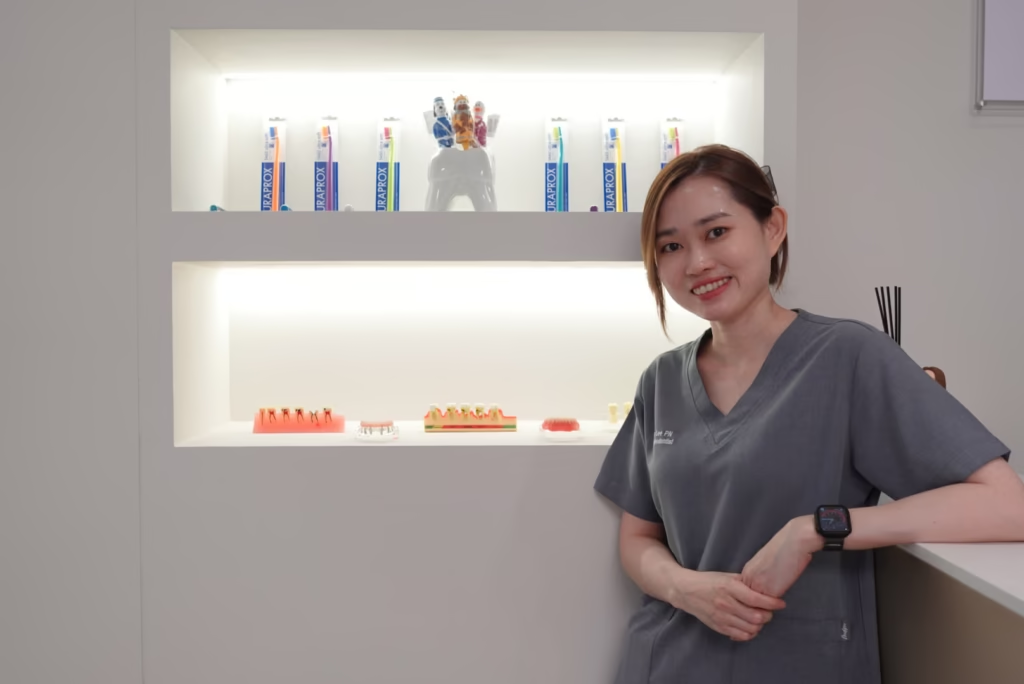
At Maison Dentaire, Dr Lee Pei Nee personally plans and delivers treatment with this restorative outcome in mind. That means assessing the final teeth first, then selecting the least invasive approach that can meet your functional and aesthetic needs. Premium implant systems and carefully designed prostheses are important, but they are only as effective as the diagnosis and planning behind them.
A consultation is the point at which uncertainty becomes a clear, individual plan. You do not need to decide on dentures or implants before attending. The immediate next step is simply to understand what your jaw can support, what each route involves, and which solution gives you the confidence to eat, speak and smile without compromise.